Intuition
The Klein–Gordon equation failed as the equation of one particle and succeeds as the equation of a field. Treat as a field in a box of volume . Its plane waves are its modes, and the Klein–Gordon equation gives each the frequency with . Quantise each mode as an oscillator: the field becomes an operator, a sum over modes of times the positive-frequency wave and times the negative-frequency one. The energy becomes and the momentum , so the one-quantum state has energy and momentum — exactly a relativistic particle of mass . The negative-frequency solutions that troubled the one-particle reading now multiply : they make a quantum of positive energy rather than describe a state of negative energy. A complex field has two kinds of quanta with opposite charges, particles and antiparticles, and the Klein–Gordon density becomes their charge, negative when antiparticles outnumber particles, as a charge may be. And the fields at two points separated by a spacelike interval commute: nothing done at one can affect a measurement at the other.
A sentence that is nonsense as a statement about one person can be sense as a statement about a crowd. The Klein–Gordon equation was nonsense about one particle and is sense about a field and its quanta.
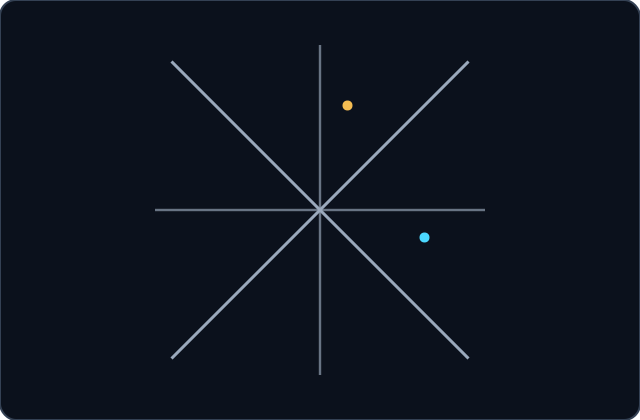
Spacetime around a point at the centre, time up and one direction of space across: the light cone, dashed, divides the points that a signal can join to , above and below it, from those it cannot, to the sides. At every to the sides, the field commutes with the field at .
The quantised scalar field
A real field obeying the Klein–Gordon equation in a box of volume is quantised mode by mode, with constants and h.c. the Hermitian conjugate of the term before it:
Properties
- The constants are fixed so that ; the momentum is (stated).
One quantum is one relativistic particle
Both operators are sums of number operators, taken normal-ordered so that the vacuum has zero energy and momentum. The number operator of a mode, commuted with the creation operator of the same mode, gives that creation operator back, and with any other mode it commutes. So the quantum carries and , which obey the energy–momentum relation of a particle of mass .
Proof steps
From .
The normal-ordered vacuum has .
The same steps, with in place of .
The frequency of the Klein–Gordon modes: the energy–momentum relation of a particle of mass .
Applications
Practice
A Quantum Is a Particle
A one-quantum state of the scalar field has energy and momentum : a particle of mass .
Try it
A quantum of a scalar field has GeV and GeV. What is its energy, in GeV?
No Negative Energies
The negative-frequency part of the quantised field multiplies a creation operator: it makes a quantum of positive energy.
Try it
In the quantised field, what becomes of the negative-frequency solutions of the Klein–Gordon equation?
Charge, Not Probability
For a complex field the Klein–Gordon density becomes the charge operator: particles count positive and antiparticles negative.
Try it
For a complex scalar field, a state with more antiparticles than particles has a charge of the opposite sign to .
Momentum of a Quantum
The momentum of the field is : each quantum in mode carries .
Try it
A state holds two quanta in the mode and one in , with in some unit. What is the size of its total momentum, in that unit?
Causality
Fields at two points separated by a spacelike interval commute, so a measurement at one cannot affect a measurement at the other.
Try it
Two points of spacetime are separated by a spacelike interval. What is true of the field operators there?
Try it
The quantised scalar field needs a filled sea of negative-energy states to be consistent.
Try it
What is the energy, in MeV, of a quantum at rest of a scalar field whose quanta have MeV? Give one decimal place.
Final checkpoint
Try it
Why did the Klein–Gordon equation fail as a one-particle equation and succeed as a field equation?
Try it
A quantum of a massless scalar field has an energy independent of its momentum.
Try it
What is the vacuum of the scalar field?
Completion
Lesson complete
Great work! You now know how to:
- quantise the Klein–Gordon field mode by mode
- show that its quanta are relativistic particles of mass
- say what becomes of the negative frequencies and the density