Intuition
Collect the states of every particle number into one space: the vacuum with no particles, the one-particle states, the symmetric or antisymmetric two-particle states, and on up. Their direct sum is Fock space. Its basis is the occupation-number states , and they are orthonormal: two lists give orthogonal states unless they agree entry by entry. A state of Fock space may be a superposition of different particle numbers — the coherent state of a laser mode, met with the oscillator, is one, with an uncertain number of photons. The total number operator measures how many particles there are. A Hamiltonian that commutes with it keeps every sector of fixed apart; processes that make or destroy particles move between sectors. For fermions the space is finite whenever the single-particle states are: each of d states is empty or filled, states in all.
A library shelves pamphlets, novels and encyclopaedias in one catalogue while keeping each book what it is. Fock space shelves the states of every particle number side by side, each sector kept apart from the others.
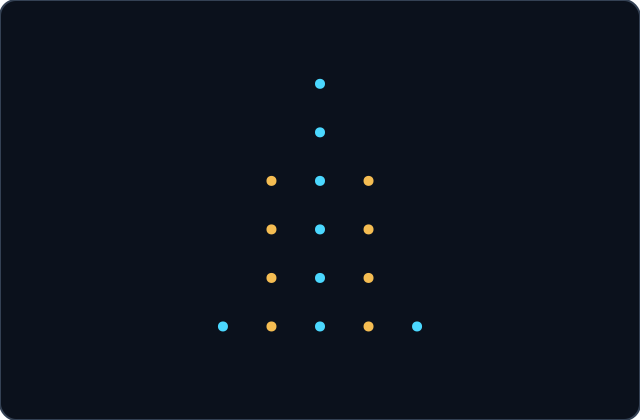
The states of Fock space for fermions with four single-particle states, one dot each, in columns by the number of particles , written under each column: states, the binomial coefficients .
Fock space
The Fock space of identical particles is the direct sum of the spaces of particles, symmetric for bosons and antisymmetric for fermions, beginning with the vacuum :
Properties
- The vacuum holds no particles; it is a state of norm 1, not the zero vector.
- The occupation-number states form an orthonormal basis of .
- has the eigenvalue on , so states with different numbers of particles are orthogonal.
Each fermion state doubles the Fock space
Add the dimensions of the sectors: fermions in states have states, and the binomial theorem sums them. The same count comes directly from the occupation numbers: each of the states is empty or filled, two choices each.
Proof steps
The sectors are orthogonal, so their dimensions add.
The count of the last lesson.
The binomial theorem with both numbers equal to 1.
The same count made directly: two choices for each state.
Applications
Practice
Empty or Filled
Each fermionic single-particle state is empty or filled, so of them give occupation-number states in all, every particle number included.
Try it
How many states does the Fock space of fermions with 5 single-particle states have?
The Vacuum
The vacuum is the state with no particles. It is a unit vector of Fock space, not the zero vector.
Try it
What is the vacuum of Fock space?
Mixed Numbers
Fock space holds superpositions of different particle numbers, such as the coherent state of a laser mode.
Try it
A state of Fock space must have a definite number of particles.
Orthonormal
Two occupation-number states are orthogonal unless their lists agree entry by entry.
Try it
What is ?
Try it
A Hamiltonian commutes with the total number operator. What does it do to a state with exactly 3 particles?
Try it
Even a single bosonic state gives an infinite-dimensional Fock space.
Try it
In the Fock space of fermions with 6 single-particle states, how many states hold exactly 3 particles?
Final checkpoint
Try it
Why are states with different numbers of particles orthogonal?
Try it
The Fock space of fermions with single-particle states has dimension 2d.
Try it
What is ?
Completion
Lesson complete
Great work! You now know how to:
- build Fock space from the sectors of every particle number
- use its orthonormal occupation-number basis
- count the states of a fermion Fock space