Intuition
An operator that acts on one particle at a time, like the kinetic energy or an outside potential, is a sum over the particles in the language of wavefunctions: . In Fock space it becomes — take a particle out of state and put it into state , with the amplitude of the one-particle matrix element. The formula is the same for bosons and fermions, and it does not mention the number of particles: one operator serves every . In the eigenbasis of it is diagonal, , each particle contributing the eigenvalue of its state. An interaction between pairs becomes : two out, two back in. Field operators remove a particle at a point, and counts the particles there. A simple model shows the method at work: particles hopping between neighbouring sites of a ring. Rewritten with waves running round the ring, the hopping is diagonal, with the energies of a band.
A shop’s price list works for any number of customers: it says what one item costs, and the till adds up whatever is bought. A one-body operator is such a price list: it says what happens to one particle, and the operators apply it to however many there are.
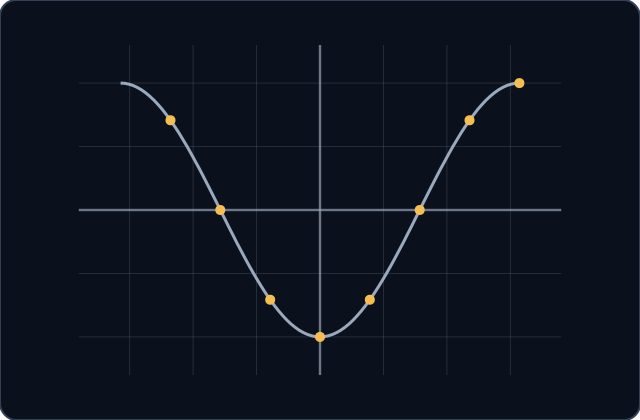
The energies of particles hopping round a ring, with and across from to . A ring of eight sites allows the eight waves , the dots; a longer ring fills the dashed band more densely.
One-body and two-body operators
An operator acting on the particles one at a time, and an interaction between pairs, become in Fock space
Properties
- The same formulas hold for fermions with in place of , and neither depends on .
- In the eigenbasis of , : free particles have .
Hopping on a ring becomes a band
Write each site operator as a sum of wave operators, , with so that site is site 1. In each product the sum over sites keeps only equal , because the phases cancel otherwise. A hop one way contributes , the hop back , and together . The same steps hold for fermions.
Proof steps
A unitary change of basis from sites to waves round the ring.
A geometric sum of -th roots of unity.
The sum over sets .
The hop back, the Hermitian conjugate of the last line.
Each wave is a one-particle eigenstate, which particles fill as bosons or as fermions.
Applications
Practice
Move One Particle
The product takes a particle out of state and puts it into state . A one-body operator is a sum of such moves weighted by the matrix elements .
Try it
What does do, for ?
Diagonal in Its Eigenbasis
In the eigenbasis of the one-body operator is a sum of eigenvalues times occupations: each particle contributes the eigenvalue of its state.
Try it
Free bosons have levels , and eV. What energy, in eV, does give the state ?
Number Kept
Each term removes one particle and adds one, so one-body operators commute with the total number operator.
Try it
A one-body operator can change the total number of particles.
A Band
Particles hopping between neighbouring sites of a ring of sites have one-particle energies , with .
Try it
On a ring of sites with eV, what is the energy, in eV, of the wave with , ?
Field Operators
The field operator removes a particle at the point , and is the density of particles there.
Try it
What does measure?
Try it
The one-body operator has the same form for bosons and for fermions.
Try it
What is the full width of the band , from its lowest energy to its highest, for eV, in eV?
Final checkpoint
Try it
How many annihilation operators does each term of a pair interaction contain?
Try it
On a ring, the waves and have different energies.
Try it
Three fermions of one spin state share a ring of 6 sites with . Which waves do they fill in the lowest state?
Completion
Lesson complete
Great work! You now know how to:
- write one-body and two-body operators with creation and annihilation operators
- see that they keep the number of particles
- diagonalise hopping on a ring into a band