Intuition
The picture the chapter has built: the world is made of fields, and particles are their quanta. That explains at a stroke why all electrons are exactly alike — each is a quantum of the same field — and why their states are antisymmetric: that is how the field’s operators anticommute. The number of particles is not sacred. Interactions are products of field operators, and the coupling of the Dirac field to the electromagnetic field removes a charged particle, puts one back and adds or removes a photon: emission and absorption are the making and removing of quanta. The square roots of the bosonic operators then have consequences anyone can see. The amplitude for an excited atom to emit into a mode that already holds photons is times the amplitude for an empty mode. At the emission still happens: spontaneous emission is emission into the empty modes of the field, which a theory with classical light cannot explain. The extra is stimulated emission, which makes lasers work. And the vacuum is not nothing: its zero-point fluctuations shift hydrogen’s 2s level — the Lamb shift — and pull plates together.
Ripples on a pond are not things added to the water; they are the water moving. Particles are the ripples of fields, each ripple a whole quantum.
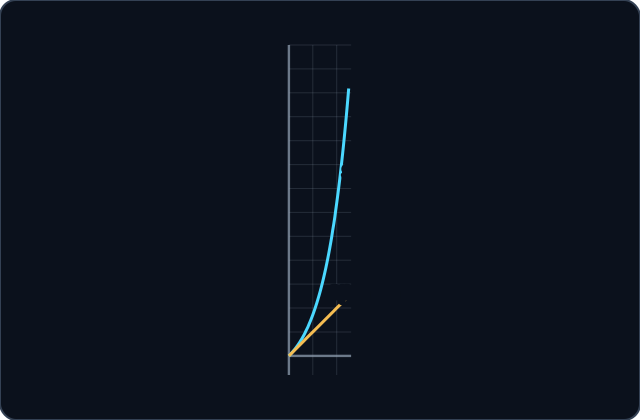
The number of photons in one mode of an ideal amplifier, every atom excited, against . Emitting at the rate , spontaneous and stimulated together, the mode fills as ; with the spontaneous rate alone, dashed, it would fill only as .
Particles as quanta
An atom with a lower level and an upper level , coupled to one mode of light with the strength , has the interaction
Properties
- Absorption takes a photon away and raises the atom; emission lowers the atom and adds a photon. The number of photons changes, the number of atoms does not.
- : the amplitude to emit into a mode holding photons is times that into an empty mode.
Emission goes as n+1
Only the emission term, which lowers the atom and adds a photon, joins to . Its matrix element splits into the atom’s part, which is 1, and the photon’s part, which is the square root of the bosonic creation operator. Squared and divided by its value for an empty mode, it gives .
Proof steps
The absorption term needs the atom in to start with, and gives zero between these states.
The bosonic creation operator.
Divide by the same quantity for an empty mode.
Emission into the empty mode happens anyway; the rest grows with the light already present.
Applications
Practice
Emission Goes as n+1
The amplitude to emit into a mode holding photons is times that into an empty mode, so the probability is times larger: 1 spontaneous, stimulated.
Try it
What fraction of the emission into a mode holding 4 photons is stimulated emission? Give a decimal.
Why Identical
Every electron is a quantum of the one electron field, so no property can tell two electrons apart.
Try it
Why are all electrons exactly alike?
Spontaneous Emission
An excited atom in empty space still emits: the has its 1 even when . A theory with classical light and no light present predicts no emission.
Try it
An excited atom in a perfect vacuum, with no photons at all, cannot emit.
Changing Numbers
The interaction keeps the number of atoms and changes the number of photons by one: absorption takes one away, emission adds one.
Try it
The atom in the state , excited with 3 photons in the mode, emits. How many photons are there afterwards?
Try it
Which term of describes absorption?
Try it
In a laser, stimulated emission puts new photons mostly into the mode that already holds the most.
Try it
In an ideal amplifier the number of photons in one mode grows as , starting from none. What is at ?
Final checkpoint
Try it
Which effect comes from the zero-point fluctuations of the electromagnetic field?
Try it
In quantum field theory the number of electrons in a process is always conserved.
Try it
What does an interaction term of the form , a charged field coupled to the electromagnetic field, do?
Completion
Lesson complete
Great work! You now know how to:
- describe particles as the quanta of fields
- derive the of emission and split it into spontaneous and stimulated
- say what the vacuum’s fluctuations do