Intuition
A field is a quantity at every point of space, like the sideways displacement of a string or the electric field in a box. Classically its motion splits into normal modes: a string of length fixed at both ends vibrates in standing waves with and frequencies , each mode on its own, and the energy of the string is a sum of one oscillator’s energy per mode. Quantum mechanics then needs nothing new: quantise each mode as an oscillator. The field’s states are the occupation-number states of its modes, and its quanta — phonons for the vibrations of a solid, photons for the electromagnetic field — are exactly the bosons of the last lessons, made and removed by the ladder operators of each mode. Each mode keeps its zero-point energy , and a field has infinitely many modes, so the sum diverges; only changes in it can be measured, and writing every creation operator to the left drops the constant. Moving two metal plates closer changes which modes fit between them, and the change in the zero-point sum is finite: it pulls the plates together, the Casimir force.
Each string of a piano sounds its own note, and a chord is a list of how loudly each string plays. A quantised field is a piano on which each string can only play at whole numbers of quanta.
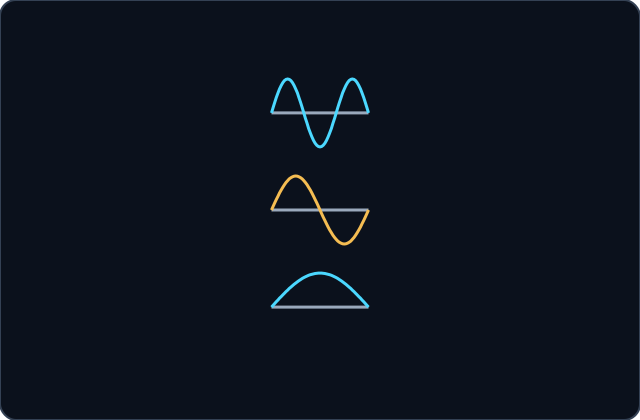
The first three normal modes of a string fixed at both ends, from the bottom, each drawn about its own dashed line: with . Each is one oscillator of frequency , and quantised, each holds a whole number of quanta.
A field as a set of oscillators
A string of length fixed at both ends, with mass per length and tension , has normal modes with and frequencies , . Quantised, it is
Properties
- Each mode is an oscillator; the field’s states are the occupation-number states of its modes, with energy .
A string is a set of independent oscillators
Put the expansion in modes into the string’s energy, kinetic plus stretching. The modes are orthonormal on the string, and so are their slopes, so every product of two different modes integrates to zero and the energy falls apart into one term per mode. Each term is the energy of an oscillator of mass and frequency , and quantising each gives .
Proof steps
Any shape with fixed ends is a sum of the modes.
The kinetic energy of each piece of string, plus the energy of stretching it.
The modes are orthonormal, and so are the cosines in their slopes: every cross term integrates to zero.
One oscillator of mass and frequency for each mode.
Quantise each oscillator with its own ladder operators; operators of different modes commute.
Applications
Practice
Modes of a String
A string fixed at both ends vibrates in standing waves with and frequencies : whole multiples of the lowest.
Try it
The lowest mode of a string has frequency 220 Hz. What is the frequency of its third mode, in Hz?
Quanta of a Field
Each mode of a field is an oscillator. Its quanta are bosons: phonons for the vibrations of a solid, photons for light.
Try it
What are photons, in this picture?
Zero-Point Energy
Every mode keeps with no quanta in it. A field has infinitely many modes, so the sum diverges; only changes in it can be measured.
Try it
The zero-point energy of a field with infinitely many modes is finite.
Energy of a Field State
A state with quanta in mode has energy ; measured from the vacuum, .
Try it
The modes of a string have . How much energy above the vacuum, in units of , does the state with 2 quanta in mode 1 and 1 quantum in mode 3 hold?
Normal Ordering
Writing every creation operator to the left of every annihilation operator drops the zero-point constant: the vacuum then has energy zero.
Try it
What does normal ordering do to the Hamiltonian of a field?
Try it
The normal modes of a free string are independent oscillators, and operators of different modes commute.
Try it
The Casimir pressure between plates a distance apart is . By what factor does it grow when is halved?
Final checkpoint
Try it
Why is each normal mode of a string a harmonic oscillator?
Try it
A mode of the electromagnetic field can hold at most one photon.
Try it
Where does the Casimir force between two neutral plates come from?
Completion
Lesson complete
Great work! You now know how to:
- split a field into normal modes and quantise each as an oscillator
- describe the field’s quanta as bosons of its modes
- say what the zero-point energy is and how it is measured