Intuition
Now give Fock space operators that change the occupations. For each single-particle state , the creation operator adds a boson to it and the annihilation operator removes one: turns into with the amplitude , and turns it into with . These are the ladder operators of the oscillator, one for each state, with the same square roots for the same reason, and the same commutator: , while operators of different states commute. Every state of Fock space is built from the vacuum by creation operators. And the symmetry of bosons comes out by itself: because the operators commute — the order in which the particles are added does not matter, which is what a symmetric state is. The square roots have a meaning: adding a boson to a state that already holds has amplitude , so bosons prefer company.
A queue attracts a queue: the longer the line at a stall, the likelier a passer-by is to join it. For bosons, the probability of joining a state that already holds is times that of entering an empty one.
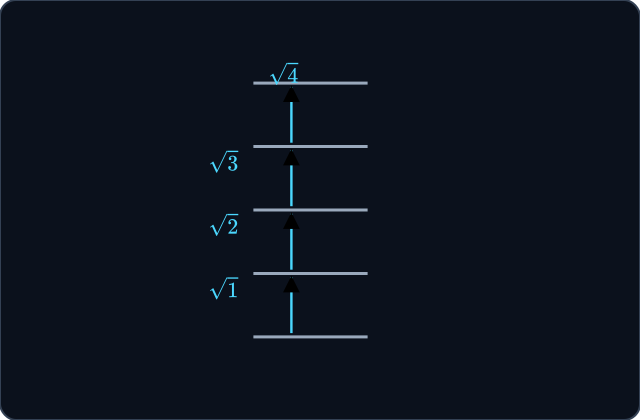
The occupations of one bosonic state, from the bottom. Each step up is taken by the creation operator, with the amplitude written beside it: .
Bosonic creation and annihilation operators
For bosons in single-particle states , the operators and act on occupation-number states as
Properties
- counts the bosons in state , and counts them all.
The norm of n bosons in one state
Move the annihilation operator to the right through the creation operators. Each passage leaves the commutator 1 behind, so , since kills the vacuum. Applied times inside the squared norm, this gives .
Proof steps
Move past one at a time; each passage leaves .
.
The squared norm, with the last line used on the right-most .
Repeat down to ; so the normalised state carries .
Applications
Practice
Adding a Boson
The creation operator adds one boson to a state, with the amplitude when are already there.
Try it
If , what is ?
Symmetric by Construction
Creation operators of bosons commute, so the order in which bosons are added never matters: the states they build are symmetric.
Try it
Why is a symmetric state of two bosons?
Nothing to Take
An annihilation operator acting on the vacuum gives the zero vector — not the vacuum.
Try it
.
Normalising
bosons made in one state by creation operators have squared norm !, so the normalised state carries .
Try it
What is the squared norm of ?
Try it
What is ?
Try it
Operators of different states commute: .
Try it
A mode holds 99 photons. How many times more probable is it that one more photon is added to it than to the same mode empty, the probability going as the squared amplitude?
Final checkpoint
Try it
Which expression is the normalised state of two single-particle states?
Try it
.
Try it
One bosonic state, with its creation and annihilation operators, is the same as what?
Completion
Lesson complete
Great work! You now know how to:
- act with bosonic creation and annihilation operators on occupation-number states
- build any state from the vacuum and normalise it
- explain why bosonic states come out symmetric