Intuition
Fermions take the same bookkeeping with one change: their operators anticommute. Define and with and all other anticommutators zero. Two consequences follow at once. Putting both operators equal in gives : a fermion cannot be added twice to one state, and the exclusion principle becomes an identity between operators. And : changing the order of adding two fermions changes the sign, which is the antisymmetry of a Slater determinant. The number operator equals its own square, so its eigenvalues are 0 and 1. Because order matters, occupation-number states are written with the operators in a fixed order, and an operator acting on a state picks up a minus sign for each occupied state it passes. The lowest state of free fermions fills the lowest levels — the Fermi sea — and its simplest excitation lifts one fermion from a filled level to an empty one, leaving a hole behind.
A car park of numbered single spaces: each is empty or holds one car, and no second car fits in a taken space. The analogy stops at the sign — swapping the order in which two cars arrive changes nothing in a car park and changes the sign of a fermion state.
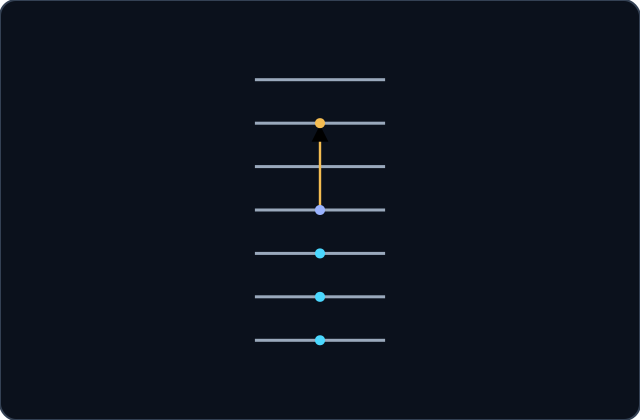
Four fermions in seven levels. In the lowest state they fill the four lowest levels, the Fermi sea; here has lifted the top one to the sixth level, leaving a hole in the sea and a particle above it.
Fermionic creation and annihilation operators
For fermions, adds a particle to state and removes one, with anticommutators :
Properties
- : no state holds two fermions — the exclusion principle as an identity between operators.
Fermionic occupations are 0 or 1
Rewrite the middle pair of with the anticommutator. The leftover term contains , which is zero, so the number operator equals its own square; an eigenvalue of such an operator has .
Proof steps
The anticommutator of with itself is .
From .
The second term contains .
Apply to an eigenvector.
Applications
Practice
No Double Occupation
Fermionic creation operators anticommute; with both equal the anticommutator gives : the exclusion principle.
Try it
What is ?
Order Matters
Swapping two fermionic creation operators changes the sign of the state they make: the antisymmetry of fermions.
Try it
If , what is ?
Zero or One
The fermionic number operator equals its own square, so every occupation is 0 or 1.
Try it
The fermionic number operator can have the eigenvalue 2.
Counting Signs
With the states in a fixed order, the creation operator of state picks up a factor for each occupied state before .
Try it
With the states ordered 1, 2, 3, 4, what sign stands in front of in ?
Particles and Holes
The lowest state of free fermions fills the lowest levels. The operator moves one fermion from a filled level to an empty level , leaving a hole.
Try it
What does do to the Fermi sea, with filled and empty?
Try it
The state is the Slater determinant of the three single-particle states.
Try it
Four fermions fill the four lowest of ten levels. How many states can be made by moving one fermion from a filled level to an empty one?
Final checkpoint
Try it
Where does the exclusion principle come from in this description?
Try it
Fermionic operators of different states commute: .
Try it
What does give on a state in which ?
Completion
Lesson complete
Great work! You now know how to:
- use anticommuting creation and annihilation operators
- derive the exclusion principle and the signs of fermion states
- describe the Fermi sea and its particle–hole excitations