Intuition
The path integral gives the same answers as the Schrödinger equation, so what is it for? First, symmetry: the action is a single number, and a symmetry of the action is visible at a glance, which is why relativistic field theories are written this way. Second, perturbation theory: expanding in the interaction gives Feynman diagrams. Third, the classical limit and semiclassical methods, from the last lessons. Fourth, and most practically, imaginary time. Replace by : the phase becomes a positive weight , with , and the path integral becomes a sum of the kind statistical physics and computers handle well. At long imaginary times every excited state dies away faster than the ground state, so the decay of the imaginary-time propagator measures the ground-state energy; and a closed path of imaginary length gives a system in thermal equilibrium. Lattice calculations of the proton’s mass run on exactly this.
A mountain range seen by day is a confusion of ridges; seen as a relief map under low evening light, its shape stands out. Rotating time to imaginary values is like that change of light: the same landscape of paths, but with weights that can be summed by chance sampling.
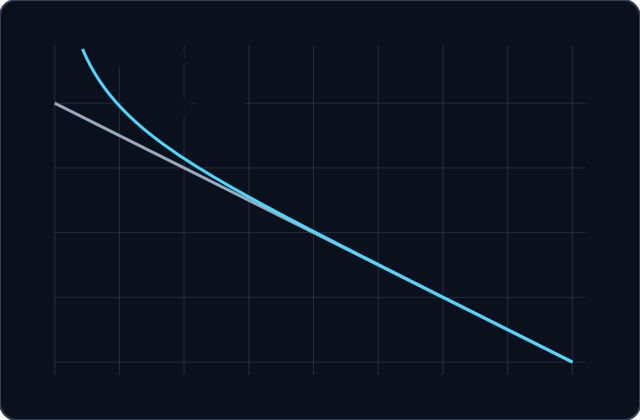
The logarithm of an oscillator’s imaginary-time trace, , against . At long times it runs parallel to the dashed line of the ground state alone: its slope is .
What path integrals are for
In imaginary time, , the propagator becomes a sum over paths with real positive weights:
Properties
- : at long the ground state dominates, and .
The ground-state energy from imaginary time
Continue the evolution operator to imaginary time: its phases become decaying exponentials, one for each level. Every excited level decays faster than the ground level, so at long times only the ground term is left, and the rate of decay of the propagator is the ground-state energy. The action continues to a positive one, so the same propagator is a sum of positive weights over paths.
Proof steps
The evolution operator continued to imaginary time.
With and .
The spectral form with real exponentials.
Each excited term decays faster by .
The last term vanishes as , wherever .
Applications
Practice
Imaginary Time
With the phases become decaying exponentials; at long the ground state decays slowest and alone survives.
Try it
With , an imaginary-time propagator falls by the factor between and , long after the excited states have died. What is ?
Positive Weights
In imaginary time the action becomes , and each path is weighted by the positive number .
Try it
Why is the imaginary-time path integral easier to compute on a computer?
The Euclidean Action
Rotating time turns the kinetic energy’s sign in the action: the imaginary-time action is kinetic plus potential energy.
Try it
In imaginary time the potential enters the action with the same sign as the kinetic energy.
What It Is For
Symmetries at a glance, Feynman diagrams, the classical limit, and imaginary-time calculations of ground states and thermal equilibrium.
Try it
Which of these is not a reason to use path integrals?
Try it
A path has . What is its weight ? Give three decimal places.
Try it
Path integrals and the Schrödinger equation are two forms of the same theory.
Try it
Thermal equilibrium at temperature uses closed paths of imaginary duration . With J s and J/K, what is it at 300 K, in units of s? Give two decimal places.
Final checkpoint
Try it
Why do the excited states drop out of the imaginary-time propagator at long times?
Try it
Random sampling works as well for the real-time path integral as for the imaginary-time one.
Try it
On a plot of against , what does the long-time slope give?
Completion
Lesson complete
Great work! You now know how to:
- say what the path integral adds to the Schrödinger equation
- rotate to imaginary time and write the Euclidean action
- derive the ground-state energy from the long-time decay