Intuition
The oscillator’s action is quadratic too, so its path integral is again exact: the classical action times a factor that depends only on the time. The classical path between the ends is a combination of and , and its action works out to . The prefactor is , which becomes the free one for short times. Something striking happens at : every classical path that leaves a point comes back to a single point, as the figure shows, and the prefactor blows up — a focus of paths. Best of all, the propagator knows the spectrum. Set and integrate over : the result is a geometric series in , and reading off its frequencies gives the energies , zero-point energy included, without solving any differential equation.
Pendulums set swinging from the same spot with different pushes all pass back through that spot together after half a swing, however hard they were pushed. The oscillator’s paths refocus the same way, and its propagator has a focus there.
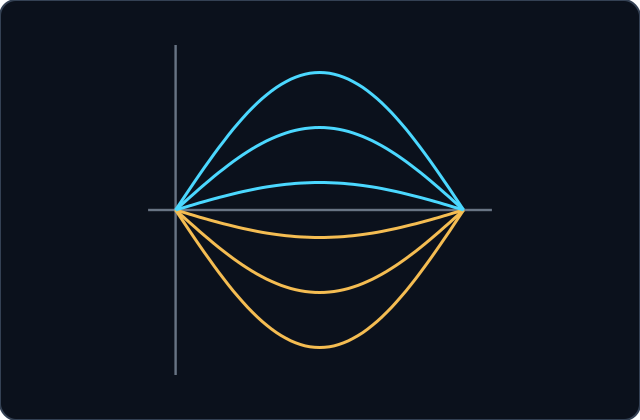
Classical oscillator paths leaving at with different speeds, , with time across in units of . Every one returns to at : the paths refocus there, and the propagator’s prefactor diverges.
The oscillator path integral
For , with :
Properties
- As it becomes the free propagator: and .
The oscillator’s energies from its propagator
Put : the classical action becomes a single Gaussian exponent, times over with a minus sign. The Gaussian integral and the prefactor combine into , which expands as a geometric series in . Comparing with the spectral form of the trace, , reads off the energies.
Proof steps
Put ; use .
A Gaussian integral.
Multiply by the prefactor; .
A geometric series, convergent when has a small negative imaginary part.
The spectral form of , integrated over with normalised .
Applications
Practice
Energies From the Trace
The integral of over is a sum of ; for the oscillator it is a geometric series with the frequencies .
Try it
From the geometric series, what is the energy of the level , in units of ?
The Free Limit
For short times the oscillator hardly feels its potential: , and the propagator becomes the free one.
Try it
What does the oscillator propagator become for ?
A Focus
Every classical path from one point returns to one point after half a period: there the prefactor diverges.
Try it
At all classical oscillator paths from a point meet again at one point.
The Zero-Point Energy
The factor in front of the geometric series is the zero-point energy , found here without any operators.
Try it
In , what does the factor give?
Try it
With , , and , what is ? Give three decimal places.
Try it
The oscillator path integral, like the free one, is exact.
Try it
An oscillator has . After what time does its propagator’s prefactor first diverge, in seconds? Give two decimal places.
Final checkpoint
Try it
Why does give the energies?
Try it
The oscillator’s prefactor is the same as the free one for all times.
Try it
Why does the oscillator path integral matter for quantum field theory?
Completion
Lesson complete
Great work! You now know how to:
- write the oscillator propagator from its classical action
- explain the focus at half a period
- derive the oscillator’s energies from the trace of its propagator