Intuition
Ask the simplest question about motion: if a particle is surely at at the time , what is the amplitude to find it at at the time ? The answer is the position matrix element of the evolution operator, , the propagator. It carries any wavefunction forward: the new wavefunction at is the old one at every , times the amplitude to get from there to , added up. Because evolving for a while and then for a while longer is the same as evolving for the whole time, propagators compose: the amplitude from to is the sum over every place the particle might pass at some middle time, of the amplitude from to times the amplitude from to . That rule, applied again and again, is the seed of Feynman’s sum over paths.
The chance of driving from one city to another through a mountain range adds up the ways through every pass; the amplitude to get from to adds up the ways through every point at a middle time — except that amplitudes, unlike chances, can cancel.
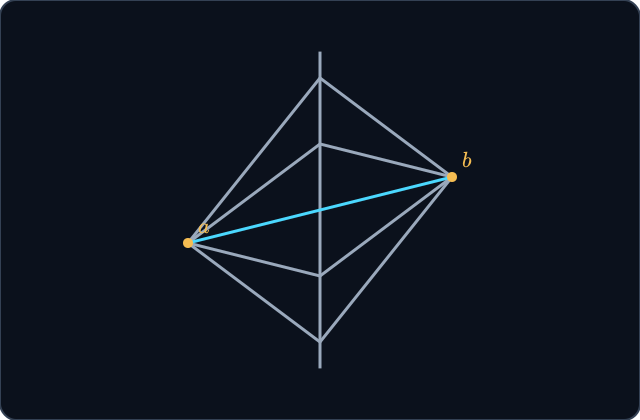
Time across and position up. The amplitude to go from to is the sum, over every position at a middle time (dashed), of the amplitude to reach times the amplitude to go on from there to . A few of the two-leg routes are drawn.
The propagator
For a Hamiltonian that does not depend on time, with , the propagator is
Properties
- It propagates wavefunctions: .
Properties of the propagator
Both follow from the evolution operator by inserting the completeness of position states: once between the operator and the old state, and once between the two factors of an evolution split at a middle time. Expanding the evolution operator in stationary states gives the spectral form.
Proof steps
Completeness of the position states.
Take the component along .
Evolving to and then on to is evolving to .
Insert between the two factors.
.
Applications
Practice
The Propagator
The propagator is the amplitude to find the particle at at , given that it was surely at at .
Try it
What is ?
Composition
Splitting a time into steps, the propagator is the product of the steps’ propagators, integrated over each position in between.
Try it
An evolution is split into 6 equal steps. Over how many intermediate positions must the composed propagator be integrated?
No Time, No Motion
As the time goes to zero, the evolution operator becomes the identity, and the propagator a delta function.
Try it
As , the propagator becomes .
The Spectral Form
Written with the stationary states, the propagator is a sum of their products, each turning at its own frequency.
Try it
Why does the propagator contain the whole spectrum of the Hamiltonian?
Try it
For a free particle . With and , what is ? Give three decimal places.
Try it
For a free particle that starts at one point, the amplitude a moment later is of the same size everywhere.
Try it
The ground-state term of an oscillator’s propagator carries the phase with . Through how many radians does it turn in the time ?
Final checkpoint
Try it
How is the wavefunction at found from the one at ?
Try it
Composing propagators adds the probabilities of going through each middle point.
Try it
Which equation does satisfy in and ?
Completion
Lesson complete
Great work! You now know how to:
- define the propagator as a matrix element of the evolution operator
- show how it carries wavefunctions and how it composes
- write it in terms of the stationary states