Intuition
For a free particle the path integral can be done exactly, and it shows how the method works in general. Write every path as the classical straight line plus a deviation that vanishes at both ends. Because the action is quadratic in the path and the straight line makes it stationary, the action splits exactly into the classical action plus the action of the deviation alone; the cross term vanishes. The integral over the deviations does not know where the ends are, so it can depend only on the time: the propagator is a function of times , with . Doing the sliced Gaussian integrals, or asking that two propagators compose into one, fixes the function: . It is exactly what the Schrödinger equation gives.
To find how a stretched string sags under its own weight you can split its shape into the smooth average curve and the wiggles about it; the wiggles do not care where the ends are pinned. The free propagator splits the same way into a classical part and a fluctuation part that depends only on the time.
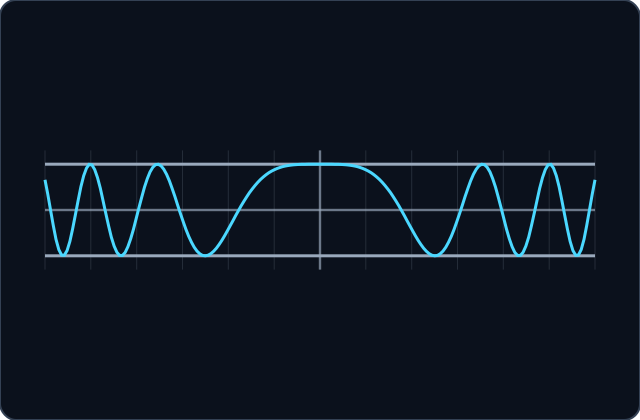
The real part of the free propagator at a fixed time, against , in units where and relative to its size (dashed): . The size is the same everywhere; the phase, the classical action over , turns faster and faster with the distance.
The free particle path integral
For a free particle of mass , with :
Properties
- The phase is with , the action of the straight path at constant speed.
The free propagator from the path integral
Split each path into the straight line and a deviation vanishing at the ends. The cross term in the action is the first-order variation about a stationary path, so it vanishes, and the action splits. The deviations’ integral depends on alone. Composing the short-time propagators, each a Gaussian, fixes it: two Gaussians of times and combine into one of time .
Proof steps
Every path is the straight line plus a deviation fixed at the ends.
The middle term is at the stationary path: it vanishes.
The straight path at constant speed.
The deviations’ integral does not involve the ends.
Each short-time kernel is ; the Gaussian integral over adds the times, and repeating it over all slices gives .
Applications
Practice
The Classical Action
A free particle goes straight at constant speed, so its action is times .
Try it
With , and , what is ?
The Action Splits
Around a stationary path, a quadratic action is the classical action plus the action of the deviation alone: the cross term is the first-order variation, which vanishes.
Try it
Why does the cross term vanish?
Exact for Quadratic Actions
When the action is quadratic in the path, the stationary-phase approximation is not an approximation: the result is exact.
Try it
For a free particle the stationary-phase result for the propagator is exact.
The Prefactor
The integral over the deviations never sees the end points, so it can depend only on the time.
Try it
On what does the prefactor of the free propagator depend?
Try it
With and , what is ? Give three decimal places.
Try it
As the free propagator tends to .
Try it
With , and , what is the phase of the free propagator, in radians?
Final checkpoint
Try it
Two free propagators, for times and , are composed by integrating over the middle position. What results?
Try it
The path integral gives a free propagator different from the one the Schrödinger equation gives.
Try it
What does the free propagator do to a Gaussian packet?
Completion
Lesson complete
Great work! You now know how to:
- split a quadratic action into classical and fluctuation parts
- derive the free propagator and its prefactor
- check it against the Schrödinger equation