Intuition
The propagator over a long time is hard to find; over a very short time it is easy, because then the kinetic and potential parts of the Hamiltonian can be applied one after the other, the error being of order , which vanishes faster than . The kinetic part is diagonal in momentum and the potential part in position, so inserting momentum states turns the short-time propagator into an integral over one momentum — a Gaussian integral that can be done exactly. What comes out is a plain number: a normalising factor times , where is the classical Lagrangian of a straight step from to . Split a finite time into such steps and compose them: the propagator becomes short-time factors, integrated over the positions in between.
A film is a stack of still frames: each frame is simple, and motion is what you get by running them quickly one after another. Time slicing replaces a hard evolution by many easy steps.
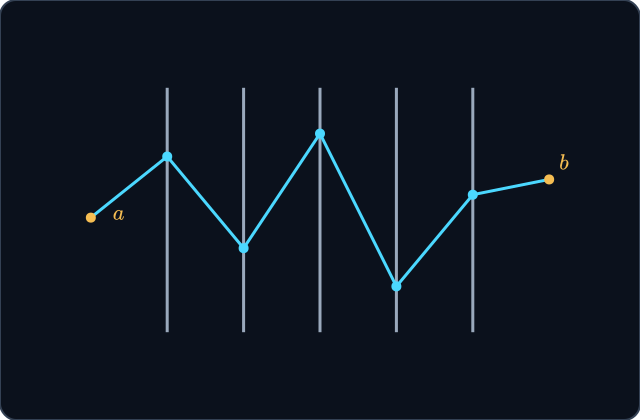
A time interval cut into six slices, dashed, with one position chosen at each cut: a broken path from to . The time-sliced propagator integrates over the position at every cut, so it sums over all such broken paths.
Time slicing
For and a short time , with :
Properties
- The error is of order in each step, so steps together err by order , which vanishes as .
The short-time propagator
Split the short evolution into a kinetic and a potential factor, at the cost of order . Insert momentum states: the potential factor gives a number at , the kinetic factor a phase in , and the overlaps plane waves. The remaining integral over is a Gaussian; completing the square gives the normalising factor and the kinetic part of the Lagrangian.
Proof steps
The two exponents differ from one by terms of order in their commutator (stated).
Insert , with .
Complete the square in .
The Gaussian integral with .
The exponent is for the straight step.
Applications
Practice
Slices
A time is cut into slices of length ; each slice is short enough to handle exactly.
Try it
A time is cut into slices. What is ?
Splitting a Short Step
For a short time the kinetic and potential factors can be applied one after the other: the error is of order , because they do not commute.
Try it
Why can be replaced by for small ?
Adding Up the Errors
An error of order in each of steps adds up to an error of order over the whole time, which vanishes as the slices shrink.
Try it
The errors of the short steps pile up into an error that does not vanish however many slices are used.
The Lagrangian Appears
The short-time propagator is a normalising factor times the phase , with the classical Lagrangian of a straight step.
Try it
What quantity appears in the exponent of the short-time propagator?
Try it
The number of slices is doubled. By what factor does the total error of the sliced propagator shrink?
Try it
The integral over the momentum in each slice can be done exactly.
Try it
With and , what is the size of the short-time prefactor? Give two decimal places.
Final checkpoint
Try it
After slicing into steps, over what is the propagator integrated?
Try it
Taking the potential at the end of a step instead of its start changes the propagator in the limit .
Try it
What makes the momentum integral converge, though its exponent is imaginary?
Completion
Lesson complete
Great work! You now know how to:
- split a short evolution into kinetic and potential steps
- derive the short-time propagator from a Gaussian integral over momentum
- compose the steps into a sliced propagator