Intuition
For everyday objects the action of any reasonable path is enormous compared with , so turns through a great many revolutions from one path to its neighbour. Neighbouring paths then cancel each other — except near a path where the action does not change to first order when the path is varied. There the neighbours arrive in step and add up. The condition is Hamilton’s principle of classical mechanics, and it gives Newton’s law, . So the classical path is not chosen by nature; it is what survives the interference of all the others as . The same stationary-phase argument, done for a single integral, gives the leading correction: the propagator becomes times a smooth factor, and the WKB wavefunction of the approximation chapter is its fixed-energy form.
A crowd clapping out of time makes a noise; the same crowd clapping in unison makes a beat. Paths far from the classical one clap out of time with their neighbours, while those near it clap together, and only the beat is heard.
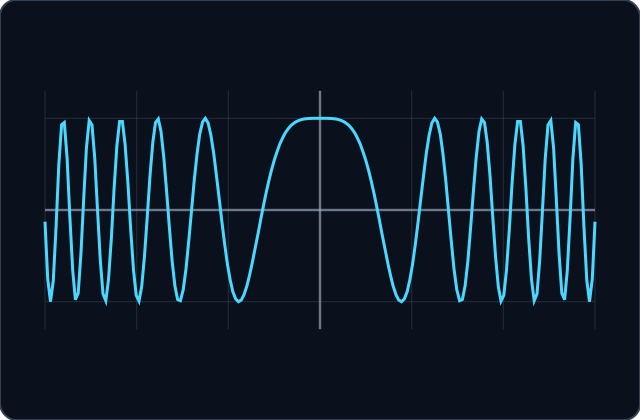
The real part of with : near the stationary point the phase hardly changes and the integrand keeps one sign, while farther out it oscillates ever faster, and neighbouring stretches cancel. As shrinks, only a neighbourhood of width about is left.
The classical limit and stationary phase
For an integral of a rapidly turning phase with a single stationary point , , , as :
Properties
- Away from stationary points the phase turns so fast that the integral cancels to higher orders in (stated).
- For the path integral the stationary paths satisfy with fixed ends: Hamilton’s principle, whose equation is Newton’s .
Stationary paths obey Newton’s law
Change the path by a small that vanishes at the ends. The action changes by the integral of . An integration by parts moves the derivative off , the boundary terms vanishing, and the change is the integral of . It vanishes for every only if the bracket does.
Proof steps
The first-order change of .
Integrate by parts; the bracket vanishes because does at the ends.
Collect the terms.
A bracket whose integral against every vanishes must itself vanish.
Only paths near the stationary one add up; the others cancel.
Applications
Practice
Stationary Phase
When the phase turns fast, neighbouring contributions cancel, except near a point where the phase is stationary: there they add in step.
Try it
Why does the classical path dominate the path integral when ?
The Fresnel Integral
The integral of over the whole line converges to times a phase : its size is .
Try it
What is the size of ? Give two decimal places.
Hamilton’s Principle
The paths whose action does not change to first order, with the ends held fixed, are exactly the solutions of Newton’s law.
Try it
The paths of stationary action with fixed ends are those that obey Newton’s law.
Integration by Parts
Varying the path, the term is integrated by parts; the boundary term vanishes because the ends are held fixed.
Try it
Why does the boundary term vanish in the variation of the action?
Try it
Paths within about of the classical one add in step. For an electron, kg, over s, with J s, what is this width, in μm? Give two decimal places.
Try it
The classical path always has the smallest action of all paths between the two ends.
Try it
A particle of mass is in the potential . By Newton’s law from the stationary action, what is at ?
Final checkpoint
Try it
In the approximation , where does the prefactor come from?
Try it
The phase of a WKB wavefunction, , is the action of the classical motion divided by .
Try it
What happens to the neighbourhood of paths that contributes as ?
Completion
Lesson complete
Great work! You now know how to:
- explain why the classical path dominates as
- derive Newton’s law from the stationary action
- apply the stationary-phase approximation to an integral