Intuition
Compose the short-time propagators and let grow without limit. The integrals over the intermediate positions become an integral over every path from to , and the phases of the steps add up to the classical action of the path, . The result is Feynman’s formula of 1948, which Dirac had glimpsed in 1933: the propagator is the sum, over all histories of the particle, of . Every path counts, however wild, and every path counts with the same weight: only its phase differs. There is no single trajectory in quantum mechanics, but there is a trajectory in the sum that matters most, the classical one, and the next lesson shows why.
A light ray from a lamp to your eye seems to take one path, the fastest; in Feynman’s account of light it tries every path, and the paths near the fastest one arrive in step while the others cancel. Particles do the same, with the action in place of the travel time.
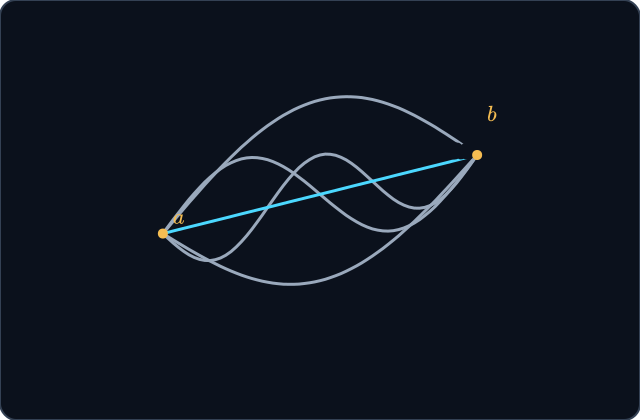
A few of the histories from to of a free particle, time across and position up. The propagator adds over all of them, each with the same size; the straight classical path, solid, is where the action is stationary.
Sum over histories
As the number of slices grows without limit, with the action of each path from to :
Properties
- means the limit of as with .
The path integral
Write the evolution over as evolutions over , insert the completeness of position states between them, and put in the short-time propagator for each. The phases add, and their sum is a Riemann sum for the action of the broken path through the chosen positions; the limit is the action of the path.
Proof steps
The evolution over as short evolutions.
Insert between the factors, with and .
The short-time propagator, with .
The phases add to a Riemann sum for the action of the broken path.
Applications
Practice
Every Path Counts
The propagator is the sum over all paths from to of . Every path has the same weight; only its phase, set by its action, differs.
Try it
In the path integral, how are the paths weighted?
The Action
The action of a path is the time integral of kinetic minus potential energy. For a free particle moving straight from to it is .
Try it
A free particle of mass moves straight from to in the time , in consistent units. What is its action?
No Single Trajectory
Quantum mechanics sums over every history. The classical path is special only because the paths near it add up in step.
Try it
In the path integral only the classical path contributes to the propagator.
From Steps to Action
The phases of the short steps add up to a Riemann sum for the time integral of the Lagrangian: the action of the path.
Try it
When the slices are composed, what do the phases of the steps add up to?
Try it
A path integral is approximated with slices. How many position integrals does it contain?
Try it
The path integral gives the same propagator as the Schrödinger equation.
Try it
A grain of mass 1 g moves at 1 cm/s for 1 s, so its action is about J s. With J s, about what power of ten is ?
Final checkpoint
Try it
What are the paths that matter in the path integral like?
Try it
Before the momenta are integrated, the same propagator is a sum over paths in position and momentum together, with the action .
Try it
Who wrote quantum mechanics as a sum over histories?
Completion
Lesson complete
Great work! You now know how to:
- compose short-time propagators into a sum over paths
- identify the phase of each path with its action
- describe the paths that contribute