Intuition
For electrons in orbitals — each orbital a spatial function together with a spin state — there is one antisymmetric state, and Slater wrote it as a determinant: the orbitals along one direction, the electrons along the other. Swapping two electrons swaps two rows, which changes the sign of a determinant: the state is antisymmetric. Putting two electrons in the same spin-orbital makes two columns equal, and the determinant vanishes: no such state exists. That is Pauli’s exclusion principle, and it builds the periodic table. An orbital with given , and holds two electrons, one of each spin; a subshell holds ; a shell holds . When electrons fill an atom’s orbitals from the bottom, they must stack upward instead of all sinking to the lowest.
A car park with numbered spaces, one car to a space: the tenth car cannot squeeze in beside the first, however much it would like the space nearest the door. Electrons fill orbitals the same way, which is why atoms have size and chemistry.
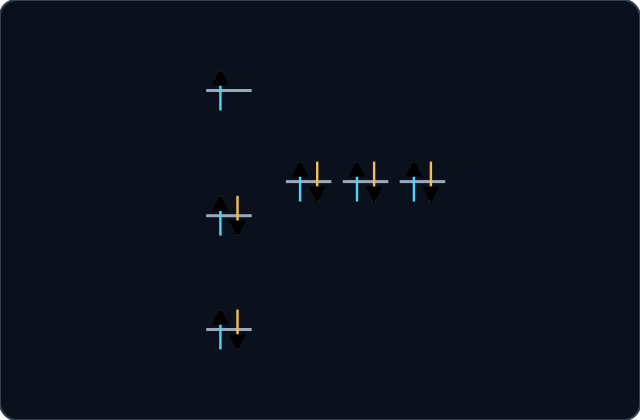
Sodium’s eleven electrons in the ground configuration . Each orbital slot holds at most two electrons, one with spin up and one with spin down, so ten electrons fill the first two shells and the eleventh has to start the third.
The Pauli principle and Slater determinants
electrons in the orthonormal spin-orbitals , with the position and spin of electron , have the antisymmetric state
Properties
- The Pauli principle: no two electrons occupy the same spin-orbital; in an atom, no two share all of , , and .
The Slater determinant
Written out, the determinant is a signed sum over the ways of assigning the orbitals to the electrons. Swapping two electrons swaps two rows, so the sign flips. A repeated orbital gives two equal columns, so it vanishes. For the norm, only the assignments that agree survive the orthogonality of the orbitals, and there are of them.
Proof steps
The determinant written out, a sum over the permutations of the electrons.
Swapping two electrons swaps two rows, which changes the sign of a determinant.
Two equal columns make a determinant vanish.
With orthonormal orbitals, a product of overlaps vanishes unless the two permutations agree; each of the that do gives 1.
Applications
Practice
The Slater Determinant
electrons in spin-orbitals have one antisymmetric state: the determinant of the orbitals evaluated at each electron, divided by .
Try it
What is the Slater determinant when two electrons are put in the same spin-orbital?
Filling Orbitals
Each orbital holds two electrons, so a subshell holds and a shell holds .
Try it
How many electrons fit in a subshell, ?
At Most Two
An orbital fixed by , and leaves only the spin free, so it holds at most two electrons.
Try it
An orbital with given , and holds at most two electrons.
Swapping Rows
Swapping two electrons swaps two rows of the matrix, and a determinant changes sign when two rows are swapped.
Try it
What happens to a Slater determinant when two electrons are swapped?
Try it
How many electrons fit in the shell ?
Try it
The exclusion principle also forbids two identical bosons from sharing a state.
Try it
How many products of orbitals does the Slater determinant of four electrons contain?
Final checkpoint
Try it
Why does the Slater determinant carry the factor ?
Try it
Every antisymmetric state of electrons is a single Slater determinant.
Try it
What orbital angular momentum and spin does a closed subshell have?
Completion
Lesson complete
Great work! You now know how to:
- write the antisymmetric state of electrons as a Slater determinant
- derive the exclusion principle from it
- count the electrons that fit in an orbital, a subshell and a shell