Intuition
The central field of the last lesson was a guess; Hartree turned it into a calculation. Give each electron its own orbital and ask the energy of the product state to be as low as possible. The answer is a set of one-electron Schrödinger equations: each electron moves in the field of the nucleus and of the charge clouds of all the others. But the clouds are made of the orbitals being sought, so the equations are solved by iteration — guess the orbitals, compute the field, solve for new orbitals, and repeat until the orbitals reproduce the field they move in: a self-consistent field. Fock replaced the product by a Slater determinant, which adds an exchange term between electrons of the same spin and removes each electron’s repulsion with itself. What remains beyond the best determinant is called correlation, about 1 eV for helium, and chemistry often needs it.
A crowd walking through a square: each person steers by where the others are, and where the others are depends on how everyone steers. Iterate the picture until nobody needs to change course, and the crowd’s pattern is self-consistent.
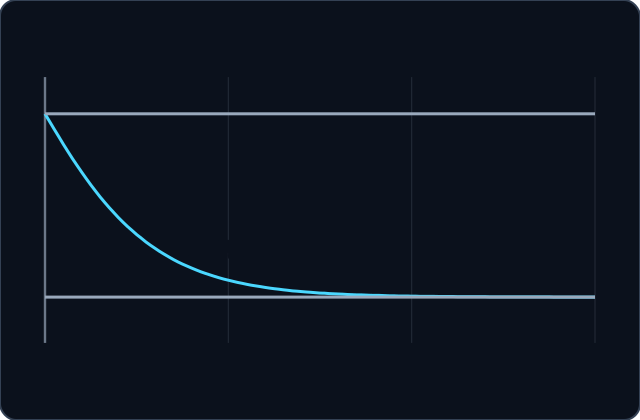
The charge one electron of helium sees at a distance from the nucleus, in units of with in Bohr radii, when the other electron is spread over a cloud of charge : . Close in it is the whole nuclear charge, 2; beyond the other electron’s cloud it is screened to 1. This is the self-consistent field in its simplest form.
The Hartree–Fock idea
Each electron moves in the field of the nucleus, , the potential of the charge cloud of all the electrons, and an exchange term from the electrons of the same spin. The orbitals solve
Properties
- includes each electron’s own cloud; cancels that self-repulsion exactly and adds the exchange between electrons of the same spin.
- is not an ordinary potential: at one point depends on everywhere.
The Hartree equations from the variational principle
Take a product of one orbital for each electron and write its average energy: one-electron energies plus the direct repulsion of each pair of clouds. Make it stationary under any change of one orbital, keeping every orbital normalised with a Lagrange multiplier. Each pair of electrons appears twice in the sum over pairs, which cancels its half, and what is left is a Schrödinger equation for one electron in the field of the others.
Proof steps
Hartree’s trial state: one orbital for each electron.
is the direct repulsion of the clouds and , and each pair is counted twice in the sum.
Make the energy stationary under every change of at every point, with the multipliers keeping the orbitals normalised.
and both contain ; their two halves make the potential of all the other clouds.
depends on the orbitals being sought: iterate until they stop changing.
Applications
Practice
Self-Consistency
Each electron moves in the field of the others’ charge clouds, which are made of the very orbitals being sought. The equations are solved by iteration.
Try it
Why are the Hartree equations solved by iteration?
What Is Missed
The best single determinant does not capture how the electrons dodge each other moment by moment. The difference from the exact energy is the correlation energy.
Try it
Hartree–Fock gives hartree for helium and the exact value is hartree. What is the correlation energy, the exact value minus the Hartree–Fock one, in hartree? Give three decimal places.
An Upper Bound Again
Hartree–Fock minimises the energy over single determinants, so like every trial energy it lies above the true one.
Try it
The Hartree–Fock energy lies above the true ground energy.
Fock’s Exchange Term
Using a Slater determinant instead of a product adds an exchange term between electrons of the same spin, and removes each electron’s repulsion with itself.
Try it
Between which electrons does Fock’s exchange term act?
Try it
Hartree–Fock gives helium’s orbital the energy hartree. By Koopmans’ theorem, what ionisation energy does that predict, in eV, with 27.21 eV per hartree? Give one decimal place.
Try it
For helium, Hartree–Fock gives the exact ground energy.
Try it
Far outside the other electron’s cloud, what charge, in units of , does one electron of helium see?
Final checkpoint
Try it
What does Hartree’s product of orbitals leave out that Fock’s determinant includes?
Try it
By Koopmans’ theorem, minus an occupied orbital energy approximates the energy needed to remove that electron.
Try it
What does the correlation energy measure?
Completion
Lesson complete
Great work! You now know how to:
- derive the Hartree equations from the variational principle
- explain the self-consistent field and Fock’s exchange term
- say what correlation energy is