Intuition
Put one particle in orbital and one in . The product will not do for identical particles; its symmetric and antisymmetric combinations will. For electrons the spin enters too, and the whole state must be antisymmetric: a symmetric spatial part goes with the antisymmetric spin singlet, an antisymmetric spatial part with the symmetric spin triplet — the singlet and triplet of the chapter on adding angular momenta, now tied to where the electrons can be. The difference shows where the particles meet. The antisymmetric combination vanishes when : two electrons of the same spin avoid each other, an exchange hole around each. The symmetric one is twice as likely there as for distinguishable particles: bosons bunch.
Two dancers who must mirror each other can never stand on the same spot, while two who must copy each other are drawn together. Antisymmetry makes fermions keep their distance; symmetry makes bosons crowd.
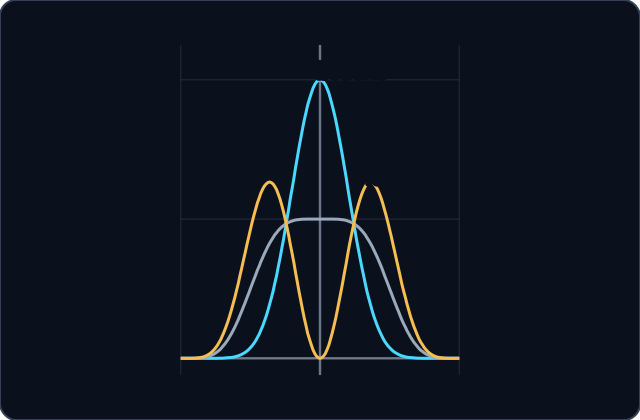
The probability density of the separation of two particles in a box of unit width, one in its lowest level and one in the next: for identical bosons, for distinguishable particles (dashed), and for identical fermions of the same spin. At zero separation the bosons’ density is twice the distinguishable one and the fermions’ vanishes — an exchange hole.
Symmetric and antisymmetric states
For orthonormal orbitals , the two-particle states of definite symmetry are
Properties
- For two electrons the whole state is antisymmetric: times the spin singlet, or times one of the three triplet states.
The exchange hole and bunching
At coinciding arguments the two terms of are the same product, so they cancel in the antisymmetric state and add in the symmetric one. The normalisation uses the orthogonality of the orbitals, which kills the cross terms.
Proof steps
The cross terms are , zero for orthogonal orbitals.
The two terms coincide.
The two terms add.
Distinguishable particles, one in each orbital: bosons are twice as likely to meet, fermions of one spin never.
Applications
Practice
Symmetrising
For orthonormal orbitals, the symmetric and antisymmetric combinations of the two products each have norm 1 after dividing by .
Try it
For orthonormal , what is for , before any normalising factor?
Space and Spin Together
The whole state of two electrons is antisymmetric: a symmetric spatial part goes with the spin singlet, an antisymmetric one with the triplet.
Try it
Which spin state goes with a symmetric spatial wavefunction of two electrons?
The Exchange Hole
An antisymmetric spatial state vanishes when the two positions coincide: electrons with the same spin keep apart.
Try it
Two electrons with the same spin can be found at the same point.
One Orbital, Two Electrons
Two electrons in the same orbital have a symmetric spatial part, , so their spins must form the singlet.
Try it
Two electrons share one spatial orbital. What is their spin state?
Try it
At coinciding positions, how many times larger is than the density of distinguishable particles?
Try it
Two identical bosons in different orbitals are more likely to be found close together than two distinguishable particles in the same orbitals.
Try it
Two electrons have one in orbital and one in orbital . How many states, counting spin, can they be in?
Final checkpoint
Try it
Which spatial state vanishes when ?
Try it
is normalised by the factor even when and overlap.
Try it
How do the three triplet spin states behave under exchange of the two spins?
Completion
Lesson complete
Great work! You now know how to:
- build symmetric and antisymmetric states of two particles
- pair the spatial states of two electrons with singlet and triplet
- show the exchange hole of fermions and the bunching of bosons