Intuition
Helium is the first atom that cannot be solved exactly: a nucleus of charge and two electrons that repel each other. Leave out the repulsion and each electron is in the 1s state of a hydrogen-like ion, for a total of eV; the measured ground energy is eV, so the repulsion matters a great deal. The ground state has both electrons in 1s, a symmetric spatial state, so their spins form a singlet. Its average repulsion, hartree, gives eV at first order. Better still, let each electron see a screened nucleus of charge and choose variationally: , and eV, within 2 per cent. The excited states come in singlets, parahelium, and triplets, orthohelium, the triplets lower by the exchange energy — and there is no triplet ground state, because two electrons in 1s cannot both have the same spin.
Two children on one seesaw with a parent in the middle: each is pulled toward the parent, but each also keeps the other a little farther out. Each electron of helium sees a nucleus partly hidden by the other.
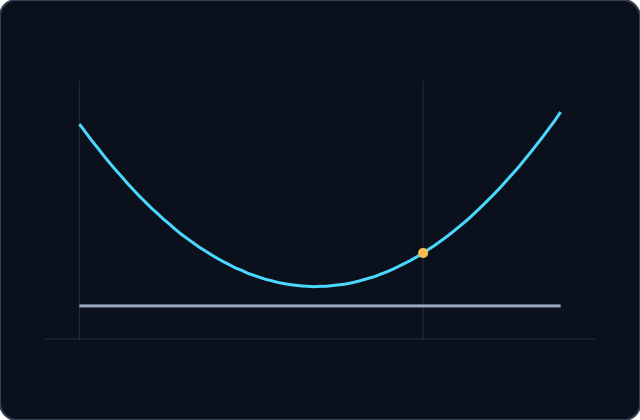
The energy of helium’s trial state against its effective charge , in hartrees: with . At , the dot, it is the first-order result, ; its lowest point, at , still lies above the measured , as a trial energy must.
The helium atom
In atomic units, with the nucleus fixed, the two electrons of an atom of nuclear charge have the Hamiltonian
Properties
- Without the repulsion the ground energy is hartree, eV for ; the measured value is hartree, eV.
The ground state of helium, variationally
Take both electrons in a orbital of adjustable charge . The kinetic and nuclear energies follow from the hydrogen chapter. The repulsion needs an integral: averaging over directions leaves , and the radial integrals give . Minimising over gives the best screened charge and an upper bound on the energy.
Proof steps
Both electrons in a orbital of charge , the spins in the singlet.
For a state of charge , and , from the hydrogen chapter’s averages.
The integral over the angle between and gives , and the other angle .
The remaining radial integrals of , done by parts.
Add the three averages.
For : and hartree, eV, against the measured eV.
Applications
Practice
Without Repulsion
Leave out the repulsion and each electron of helium is in the 1s state of a hydrogen-like ion with , at eV.
Try it
Without the repulsion, each electron of helium would have the energy eV. What is the total, in eV?
Screening
Each electron partly hides the nucleus from the other, so each sees an effective charge smaller than .
Try it
Why does the best trial charge come out smaller than the nuclear charge ?
An Upper Bound
The trial energy is the average energy of an actual state, so the variational principle puts it above the true ground energy.
Try it
The variational estimate hartree lies above helium’s true ground energy.
The Ground State
Both electrons of helium’s ground state are in 1s, a symmetric spatial state, so the spins form a singlet.
Try it
What is the total spin of helium’s ground state?
Try it
The average repulsion in helium’s unscreened state is hartree, or 34.0 eV. What is the first-order ground energy, in eV?
Try it
Removing one electron from helium costs about 24.6 eV.
Try it
What is the best effective charge for helium? Give two decimal places.
Final checkpoint
Try it
Which lies lower, the singlet or the triplet of helium’s configuration?
Try it
The first-order result gives helium’s ground energy to within 0.1 per cent.
Try it
Why is there no triplet state with both electrons in ?
Completion
Lesson complete
Great work! You now know how to:
- estimate helium’s ground energy at first order and variationally
- explain the screened charge
- tell parahelium from orthohelium