Intuition
The Hamiltonian of two electrons contains no spin at all, only their kinetic energies, the nucleus’s pull and their repulsion. Yet the spin decides the energy, through the symmetry of the spatial part. Put one electron in orbital and one in . The average repulsion has two parts: the direct energy of the two charge clouds, which any two charges would have, and the exchange energy , which exists only because the spatial state is symmetric or antisymmetric. The singlet, with symmetric space, gets ; the triplet, with antisymmetric space, gets . is positive, so the triplet lies lower: electrons with parallel spins keep out of each other’s way and repel less. The resulting splitting looks like a strong magnetic coupling of the spins, but it is electrostatics and antisymmetry.
Two commuters who happen to take the same train sit close together half the time; two who have agreed never to be in the same carriage bump into each other less. The triplet’s antisymmetry is such an agreement, and it saves repulsion.
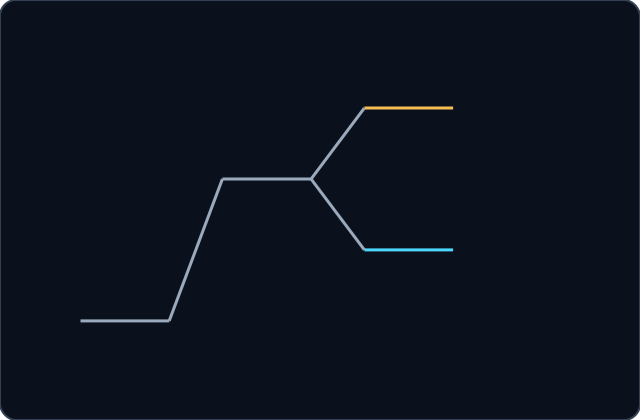
The energy of two electrons in different orbitals: without their repulsion on the left, raised by the direct energy in the middle, and split by the exchange energy on the right — the singlet at above, the triplet at below, apart.
Exchange effects
Two electrons in orthonormal orbitals , with the repulsion , have the average energies
Properties
- ; the upper sign, symmetric space, is the singlet, the lower sign the triplet.
Direct and exchange energies
Expand the average repulsion in the symmetrised state into four terms. The repulsion is unchanged by swapping the electrons, so the four are two equal pairs: the direct energy and the exchange energy. The exchange energy is the Coulomb energy of a complex charge density with itself, which an integration by parts turns into the positive integral of the square of its field.
Proof steps
The spatial states of the singlet, , and the triplet, .
Four terms, with .
is symmetric in : renaming the variables of integration makes each pair equal, and real.
Add the energies of the two orbitals.
is the Coulomb energy of the complex density with itself; with its potential, Poisson’s equation and an integration by parts give this integral.
Applications
Practice
Direct and Exchange
The average repulsion of two electrons is in the singlet and in the triplet.
Try it
Two electrons have eV and eV. How far above the triplet does the singlet lie, in eV?
Triplets Lie Lower
is positive, so the triplet, with its antisymmetric spatial state, has the lower energy.
Try it
For two electrons in different orbitals, which spin state has the lower energy?
Not Magnetism
The singlet–triplet splitting comes from the Coulomb repulsion and the symmetry of the state, not from any magnetic interaction of the spins.
Try it
The splitting between singlet and triplet comes from the magnetic interaction between the two spins.
Keeping Apart
The antisymmetric spatial state vanishes where the electrons meet, so electrons with parallel spins spend less time close together.
Try it
Why do electrons with parallel spins repel each other less on average?
Try it
Two electrons have eV, eV and eV. What is the energy of the triplet, in eV?
Try it
The exchange energy of the Coulomb repulsion is positive.
Try it
Helium’s triplet lies 19.82 eV and its singlet 20.62 eV above the ground state. What is , in eV? Give two decimal places.
Final checkpoint
Try it
The exchange splitting can be written as a term in the spins alone. Which?
Try it
Two distinguishable particles with the same charges and orbitals would show the same singlet–triplet splitting.
Try it
What lines up the spins of neighbouring atoms in iron?
Completion
Lesson complete
Great work! You now know how to:
- split the average repulsion into direct and exchange energies
- show that the triplet lies below the singlet
- explain why exchange looks like a coupling of spins