Intuition
Two billiard balls painted alike can still be told apart: follow each along its path, and the one that ends in the corner pocket is the one that started on the left. Quantum particles have no paths to follow. Once the wavefunctions of two electrons overlap, there is no fact of the matter about which is which, and electrons are identical in every property — mass, charge, spin. So the state with the first particle at and the second at must describe the same physics as the state with them swapped. The exchange operator swaps the labels. It squares to one, so its eigenvalues are and , and because the Hamiltonian of identical particles treats them alike, it commutes with the Hamiltonian: a state that is symmetric or antisymmetric stays so for ever.
Two identical coins in a bag: after a shake, it makes no sense to ask whether the coin on the left is the one you put in first. For classical coins the question is merely unanswerable in practice; for electrons it has no answer at all.
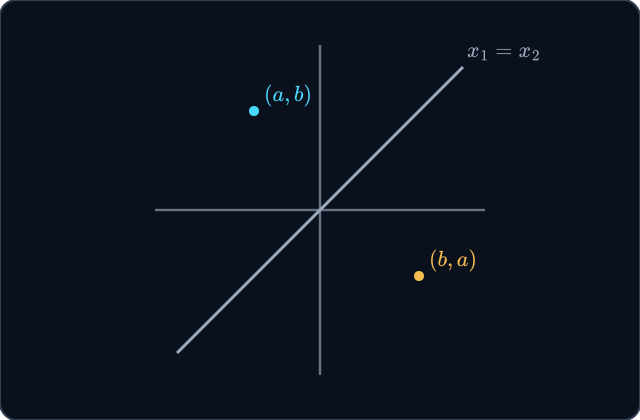
The plane of the two positions, across and up. Exchanging the particles reflects a point in the diagonal . For identical particles the configurations and are one and the same, so takes the same value at both.
Indistinguishable particles
For two identical particles, with standing for a position and a spin component together, the exchange operator swaps their labels:
Properties
- is Hermitian and unitary, with the eigenvalues , the symmetric states, and , the antisymmetric states.
- The Hamiltonian of identical particles is unchanged by swapping them; if it were not, the particles could be told apart by how they move.
The exchange operator
Swapping twice changes nothing, so the operator squares to one. Renaming the variables of integration shows that it is Hermitian. An eigenvalue must then square to one, and since the Hamiltonian is symmetric the operator commutes with it and the symmetry is conserved.
Proof steps
Swap, and swap back.
Rename in the integral.
A Hermitian operator has real eigenvalues, and these square to one.
Then is conserved, by the equation of motion of the dynamics chapter.
Applications
Practice
No Paths to Follow
Classical particles can be told apart by following their paths. Quantum particles have none, so identical ones cannot be tracked once their wavefunctions overlap.
Try it
Why can two electrons not be told apart by following them?
Identical Means Interchangeable
For identical particles, a state and the same state with the labels swapped describe the same physics.
Try it
Two classical billiard balls that look exactly alike can still be told apart by following them.
The Exchange Operator
The exchange operator swaps the labels of two particles. Swapping twice changes nothing.
Try it
Two particles each have three single-particle states . How many product states are there?
Swapping Twice
The exchange operator squares to the identity, so its eigenvalues are and .
Try it
What is ?
Try it
What is the eigenvalue of on ?
Try it
For , the product is an eigenstate of .
Try it
Of the nine product states of two particles with three states each, how many are left unchanged by ?
Final checkpoint
Try it
Which condition must the wavefunction of two identical particles satisfy?
Try it
The exchange operator swaps the spins of the two particles as well as their positions.
Try it
Why does a symmetric state of identical particles stay symmetric as it evolves?
Completion
Lesson complete
Great work! You now know how to:
- explain why identical quantum particles cannot be told apart
- define the exchange operator and find its eigenvalues
- show that the symmetry under exchange is conserved