Intuition
An atom with many electrons is described first by a central field: each electron moves in the spherically symmetric average of the nucleus and all the others, the full charge close to the nucleus and a single charge far out. The levels are still labelled , but screening removes hydrogen’s degeneracy in : an s electron reaches in close to the nucleus and is bound more tightly than a p electron of the same shell, and so on. Filling the levels in order, two to an orbital, gives the configurations and the periodic table: 1s, 2s, 2p, 3s, 3p, 4s, 3d. What the central field leaves out — the rest of the repulsion — splits a configuration into terms of definite total and , written , and the spin–orbit coupling splits a term into levels of definite . Hund’s rules, found empirically, say which term lies lowest: the largest , then the largest , then the smallest if the shell is less than half full and the largest if more.
Seats in a stadium are filled from the front, but which rows count as the front depends on the view: the seats are closer to the pitch than their row number suggests. Hund’s rules then settle who sits next to whom within a row.
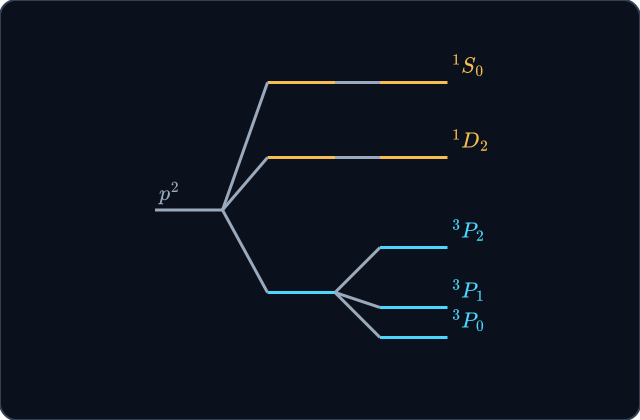
Carbon’s outer configuration , split by the repulsion beyond the central field into the terms , and — the triplet lowest, by Hund’s first rule — and by the spin–orbit coupling into levels of definite . The shell is less than half full, so is the ground level, and the gaps above it grow as , by Landé’s interval rule. Not to scale.
Many-electron atoms
In the central-field approximation each electron moves in a spherically symmetric potential, close in and far out. Its levels fill in the order
Properties
- A configuration, such as carbon’s , lists how many electrons occupy each subshell; closed subshells have and drop out of the rest.
The terms of two equivalent p electrons
Count the states: two electrons in six spin-orbitals. Then sort them by symmetry. For two orbital angular momenta 1, the total and are symmetric under exchange and antisymmetric; the whole state must be antisymmetric, so the symmetric spin triplet goes with and the antisymmetric singlet with and 2. The states add back up to fifteen.
Proof steps
Two electrons in two different spin-orbitals among the six of .
The top state of , , is symmetric and lowering keeps it so; takes the antisymmetric combination at ; is what is left at , symmetric.
The whole state is antisymmetric: a symmetric spin part needs an antisymmetric orbital part, and the other way round.
states in each term.
Hund’s rules: the largest ; the subshell holds two of six, less than half, so .
Applications
Practice
Configurations and Terms
A configuration says how many electrons are in each subshell. Its states split into terms of definite and , each with states.
Try it
How many states does the configuration have, two electrons in the six spin-orbitals of ?
Hund’s Rules
Lowest lies the term with the largest , then the largest ; the lowest level has below half filling and above.
Try it
By Hund’s first rule, which term of a configuration lies lowest?
Screening Splits l
In a many-electron atom an s electron penetrates the inner shells and feels more of the nucleus than a p electron of the same shell, so the levels depend on as well as .
Try it
In the central-field approximation, the energy of a level depends on alone, as in hydrogen.
Carbon
Carbon’s gives the terms , and . The triplet lies lowest, and with the subshell less than half full, .
Try it
What is the ground level of carbon, ?
Try it
How many states does the term contain?
Try it
Nitrogen’s ground configuration has total spin .
Try it
By Landé’s interval rule, what is the gap between and divided by the gap between and ?
Final checkpoint
Try it
Why does fill before in potassium and calcium?
Try it
Oxygen’s subshell is more than half full, so its ground level has .
Try it
Why can the closed subshells be left out when finding the terms of an atom?
Completion
Lesson complete
Great work! You now know how to:
- build configurations in the central-field approximation
- find the terms of two equivalent p electrons
- use Hund’s rules to find a ground level