Intuition
In a number state the particle is on average at the centre and at rest, yet its position and momentum spreads grow with every quantum added, both as . The energy is shared equally between kinetic and potential, as it is for a classical oscillator averaged over a swing. And for large the density itself begins to look classical: it piles up near the ends of the swing, where a classical particle slows down and lingers.
A pendulum photographed at random moments is most often caught near the ends of its swing, where it moves slowly, and least often in the middle, where it rushes through. A highly excited oscillator’s density has the same shape, with ripples.
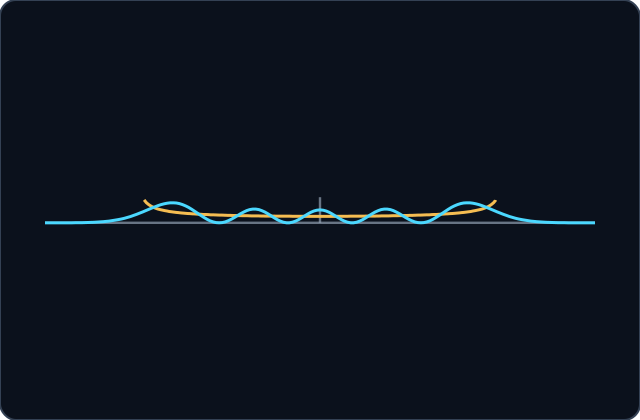
The density of the state with four quanta, against the density of a classical oscillator of the same energy, which swings to in units of . Averaged over its ripples the quantum density follows the classical one, and both are largest near the ends of the swing.
Spreads in the number states
Writing and through the ladder operators turns every average in a number state into a count of quanta. Averages of and vanish; averages of their squares grow with .
Properties
- in every : and change by one, and different number states are orthogonal.
The spread of position in a number state
Write through the ladder operators and square it. The terms and change by two and average to zero; the mixed terms count quanta, and .
Proof steps
Invert the definitions of the ladder operators.
Square, keeping the order of the mixed terms.
They change by two, and is orthogonal to .
Use and .
Collect. Since , this is .
Applications
Practice
Growing Spread
In the -th state the mean square position is , while the mean position is zero.
Try it
In units with , what is in the state ?
No Average Displacement
Position and momentum each change the number of quanta by one, so their averages in any single number state vanish.
Try it
In the state the average position is zero.
The Product
The two spreads grow together, and their product is times .
Try it
What is in the state , in units of ?
Equal Shares
In every number state the average kinetic and potential energies are equal, each half the total.
Try it
An oscillator with eV is in the state . What is ?
Try it
By what factor is in the state larger than in the ground state?
Try it
Every number state meets the uncertainty relation with equality.
Try it
For large , where is a particle in most likely to be found?
Final checkpoint
Try it
In units with , what is in the state ?
Try it
A classical oscillator with the energy of swings out to . How does in compare with ?
Try it
An oscillator with eV is in the state . What is , in eV?
Completion
Lesson complete
Great work! You now know how to:
- compute and in number states with ladder operators
- find the uncertainty product