Intuition
In the Heisenberg picture the oscillator is solved in one line: the lowering operator just turns with a phase, and position and momentum then move exactly like the classical coordinates. So every average swings at the frequency , whatever the state. A number state has nothing to swing — its averages are zero and stay zero — but a superposition of neighbouring levels sways from side to side at exactly the classical frequency.
A swing pushed off at any height comes back at the same rate: that is what a harmonic force does. The quantum oscillator keeps the rule for its averages, whatever its state.
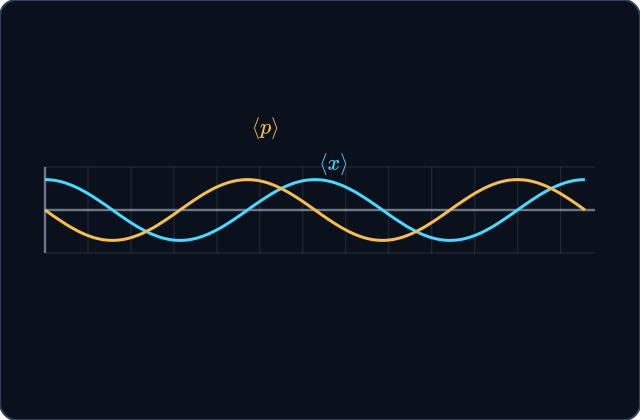
The averages of position and momentum in the state over two periods, in units of and against : and , the motion of a classical oscillator released from rest.
Motion in the Heisenberg picture
Heisenberg’s equation for the lowering operator is solved at once, and position and momentum then move exactly as classical ones do. Every average oscillates at , whatever the state.
Consequences
- In every state, : the classical motion, as Ehrenfest’s theorem promises for a quadratic potential.
Position in the Heisenberg picture
Heisenberg’s equation for uses its commutator with the Hamiltonian, which is , so only acquires a phase. Rebuilding from and its adjoint turns the phases into a cosine and a sine.
Proof steps
Heisenberg’s equation of motion.
The commutator from the lesson on ladder operators.
Solve, and take the adjoint.
at each time.
Substitute and through and : the phases combine into and .
Applications
Practice
Back After One Period
Every state of the oscillator returns to itself, up to an overall phase, after one classical period, because all its energies differ by whole quanta.
Try it
An oscillator has per second. After how many seconds does every state first return to itself, up to an overall phase?
The Ladder Operators Turn
Heisenberg’s equation for the lowering operator gives , so it only acquires a phase as time passes.
Try it
What is in the Heisenberg picture?
Number States Stand Still
In a number state every average is constant in time, as in any stationary state: the phase of the state cancels in every expectation value.
Try it
In the state , oscillates at the frequency .
A Swaying Density
The superposition of the two lowest states has a mean position that swings at the classical frequency, with amplitude .
Try it
In units with , what is the largest value reaches in the state ? Give three decimal places.
Try it
With , a state has and at . What is at ?
Try it
Which state has a mean position that moves?
Try it
For the harmonic oscillator, the averages and follow the classical equations of motion exactly, in every state.
Final checkpoint
Try it
The state has energies and . After what fraction of a classical period does its probability density first repeat? Give three decimal places.
Try it
With in units of and in units of , what path does the point trace over time?
Try it
In the Heisenberg picture the number state itself changes in time.
Completion
Lesson complete
Great work! You now know how to:
- solve Heisenberg’s equations for , and
- explain why averages follow the classical motion exactly
- tell which superpositions sway and which stand still