Intuition
Near the bottom of any smooth valley the potential is a parabola: expand it about its minimum and the first term that matters is quadratic. So a molecule’s bond, an atom in a crystal, a mode of an electric circuit and a mode of light all vibrate, for small motions, like a mass on a spring. The quantum harmonic oscillator is therefore the most used model in physics, and it has a remarkable answer: its energies are evenly spaced, one quantum apart, and the lowest is half a quantum above the bottom.
A marble in any bowl, pushed gently, rocks back and forth as if the bowl were a perfect parabola. Only large swings feel the bowl’s true shape.
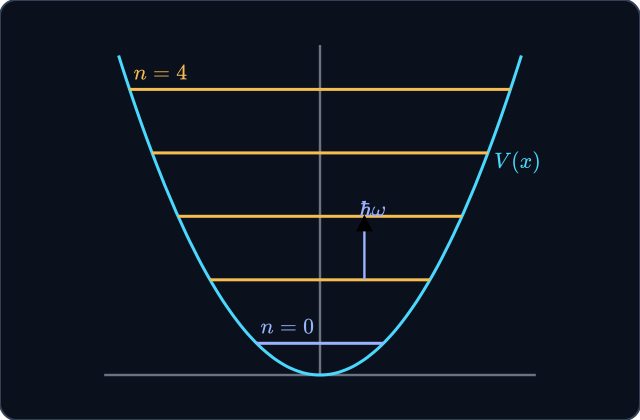
The potential and its first five levels, in units of and of the oscillator length . Each level is drawn as far as a classical particle of that energy could go. The levels are : one quantum apart, and the lowest is not at the bottom.
The oscillator and its scales
A particle of mass in the potential . Measured in the units the oscillator itself supplies — a length, a momentum and an energy built from , and — every oscillator is the same problem.
What to know first
- Near a minimum at , : an oscillator with .
The oscillator in its own units
Write the Hamiltonian in the position representation and change the variable to . The kinetic term gains and the potential term ; choosing makes both coefficients .
Proof steps
The Hamiltonian acting on wavefunctions, with .
Each derivative with respect to is times one with respect to .
Substitute both.
This choice of makes the two coefficients equal.
Factor out : no constant is left in the bracket.
Applications
Practice
Every Minimum Is a Parabola
Expand any smooth potential about a minimum: the constant does nothing, the linear term vanishes at the minimum, and the quadratic term is the first that matters. Small vibrations about any minimum are therefore harmonic.
Try it
Why does the harmonic oscillator describe small vibrations of almost any system?
The Frequency From the Curvature
The curvature of the potential at its minimum plays the part of the spring constant, and the frequency follows from it and the mass.
Try it
A particle of mass 4 sits at the minimum of . What is ?
The Natural Length
The oscillator has its own length scale, at which the kinetic and potential energies of a quantum are equal. Every quantum distance in the problem is a multiple of it.
Try it
With , and , what is the oscillator length ?
Evenly Spaced Levels
The energies of the quantum oscillator are one quantum apart, starting half a quantum above the bottom of the potential. The next lessons derive this without solving a differential equation.
Try it
The gap between neighbouring levels of a quantum oscillator grows with the energy.
Try it
A molecule vibrates with eV. What is its lowest vibrational energy, in eV?
Try it
In the variable , what does the oscillator Hamiltonian become?
Try it
In units with , a classical oscillator has energy . How far from the centre does it turn back?
Final checkpoint
Try it
Which combination is the oscillator’s natural momentum scale?
Try it
An oscillator has meV. What is , in meV?
Try it
The period of a classical harmonic oscillator is the same for every amplitude.
Completion
Lesson complete
Great work! You now know how to:
- explain why an oscillator sits at the bottom of every smooth well
- find the frequency from the curvature of a potential
- rewrite the Hamiltonian in the oscillator’s natural units