Intuition
Raising the Gaussian once multiplies it by ; raising again gives a quadratic times the same Gaussian; each rung adds one degree to the polynomial in front. The polynomials are Hermite’s, known long before quantum mechanics. They carry everything visible about the excited states: the -th has nodes, and the states alternate between even and odd because the potential looks the same from both sides.
The modes of a plucked string are sines with one more crossing each; the modes of the oscillator are the same idea in a parabolic bowl, each with one more crossing than the last and all fading away at the edges.
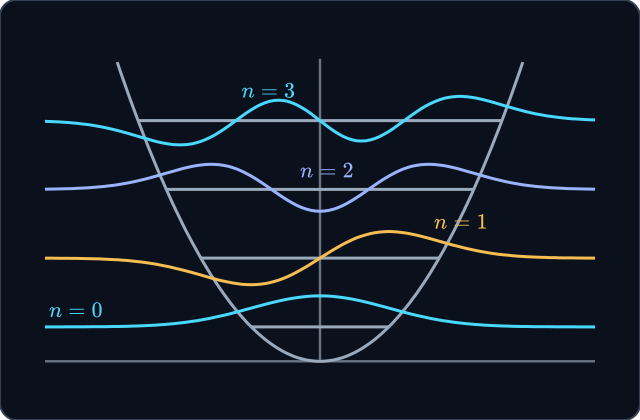
The first four states of the oscillator, each drawn on its own level inside the potential, in units of and . The -th has nodes, the states are even and odd in turn, and each reaches a little beyond the dashed stretch a classical particle of its energy could cover.
The excited states
Raising the ground state times with gives a polynomial of degree times the same Gaussian. The polynomials are the Hermite polynomials .
Properties
- , , , .
Raising the ground state once and twice
Apply in its position form to the Gaussian: differentiating brings down , and the minus sign in doubles the already there. Applying it again to gives the quadratic, and the factor of is divided out.
Proof steps
The adjoint of : the derivative changes sign.
The derivative of the Gaussian is times it.
Multiply by the normalisation ; needs no further factor.
The derivative of is .
Divide by , since . This is with its normalisation.
Applications
Practice
n Nodes
The -th state is a polynomial of degree times a Gaussian, and the polynomial has real zeros: the state has nodes.
Try it
How many nodes does the oscillator state have?
Even and Odd
The potential is the same at and , and the states take turns: , , are even and , , are odd.
Try it
What is ?
The Recurrence
Each Hermite polynomial follows from the two before it, so any of them can be written down in a few lines.
Try it
From and , what is the constant term of ?
Orthonormal
States of different energy are orthogonal, because the Hamiltonian is Hermitian. For the oscillator this makes the Hermite functions orthonormal.
Try it
.
Try it
What is ?
Try it
Which oscillator states vanish at the centre of the well?
Try it
Where is the positive node of , in units of ? Give three decimal places.
Final checkpoint
Try it
What is , up to a constant factor?
Try it
acting on a polynomial of degree times gives a polynomial of degree times the same Gaussian.
Try it
A particle is in the state . What is the probability of finding it at ?
Completion
Lesson complete
Great work! You now know how to:
- raise the ground state into Hermite functions
- use the Hermite recurrence and count nodes
- tell even oscillator states from odd ones