Intuition
The bottom rung is the state the lowering operator kills, and in the position representation that condition is a first-order differential equation. Its solution is a Gaussian, the shape the chapter on position and momentum met as the state of least uncertainty. Its energy is half a quantum, the zero-point energy: the oscillator can never be still at the bottom, because a state with no spread in position and none in momentum does not exist.
A ball in a bowl can be put at rest at the very bottom. A quantum particle cannot: pinning it to the bottom would make its momentum wildly uncertain, and letting it spread costs potential energy. The ground state is the best compromise.
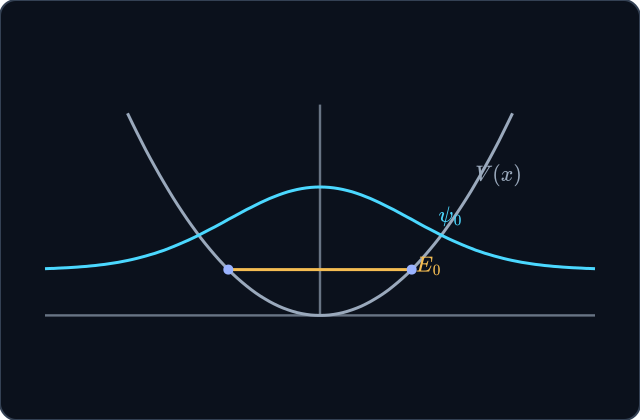
The ground state drawn on its level , with . A classical particle with this energy would stay between the two dots, at . The quantum state reaches beyond them: the probability of finding it outside is about 0.16.
The ground state
In the position representation the lowering operator is a first-order differential operator, so is an equation with one solution up to a factor: a Gaussian of width about .
Properties
- In : .
Solving the ground state
Write the lowering operator in the variable : it is up to a factor. Killing a state then means , which is separable and gives a Gaussian. Normalising fixes the constant, and the Hamiltonian written with ladder operators gives the energy at once.
Proof steps
The lowering operator in , using .
The condition : a first-order equation.
Separate the variables and integrate: .
The Gaussian integral, so .
Since , only the half quantum survives.
Applications
Practice
Never at Rest
The lowest energy of the oscillator is half a quantum, the zero-point energy. A particle resting at the bottom would have no spread in position and none in momentum, which the uncertainty relation forbids.
Try it
The vibration of a molecule has eV. What is its zero-point energy, in eV?
A Gaussian
The lowest state solves a first-order equation, , whose solution is a Gaussian centred at the bottom of the well.
Try it
What shape is the oscillator’s ground-state wavefunction?
Beyond the Classical Limits
A classical oscillator with energy would never go farther than from the centre. The ground state reaches beyond, with a probability of about 16 per cent.
Try it
In its ground state, an oscillator is never found where exceeds .
Least Uncertainty
In the ground state and . Their product is , the smallest the uncertainty relation allows.
Try it
In units with , what is in the ground state? Give three decimal places.
Try it
A state with and the least allowed has energy . With , what is the least value of for ?
Try it
Which condition picks out the ground state of the oscillator?
Try it
Zero-point energy has measurable consequences, such as different bond strengths for different isotopes.
Final checkpoint
Try it
is normalised over . What is ? Give three decimal places.
Try it
An atom in a molecule is replaced by a heavier isotope; the spring between the atoms is unchanged. What happens to the zero-point energy?
Try it
The oscillator’s ground state meets the uncertainty relation with equality.
Completion
Lesson complete
Great work! You now know how to:
- solve for the Gaussian ground state
- explain the zero-point energy by the uncertainty relation
- compute spreads and probabilities in the ground state