Intuition
Of all the oscillator’s states, which moves most like a classical particle? The answer is a Gaussian with the ground state’s width, displaced from the centre: it swings back and forth at the classical frequency and never spreads. These coherent states are eigenstates of the lowering operator, their numbers of quanta are Poisson-distributed, and the light of a laser is one.
A crowd of runners on a circular track, released together and all running at exactly the same speed, stays a tight bunch for ever. A coherent state is a bunch like that: every part of it moves at the one frequency the oscillator allows, so nothing drifts apart.
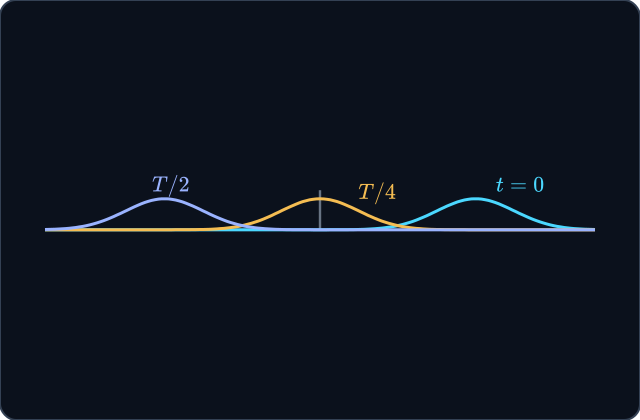
The density of the coherent state with at three moments, in units of : at centred at , a quarter period later passing the centre, half a period later at . The packet keeps the ground state’s shape the whole time.
Coherent states
For any complex number , the state below is an eigenstate of the lowering operator with eigenvalue . It is a Gaussian of the ground state’s width, centred and moving according to .
Properties
- is the coherent state with . Lowering the sum term by term gives times the same sum, which is the eigenvalue equation.
- and , with and , as in the ground state.
A coherent state stays coherent
Each number state in the sum only acquires the phase of its energy. Taking out the half quantum’s phase, the rest multiplies by , which is — the same sum with turned, and the same normalisation, since turning does not change .
Proof steps
The coherent state in number states.
Each number state is stationary and acquires its own phase.
Take the half quantum’s phase out of the sum and join to .
Turning keeps its modulus, so the normalising factor is the right one.
A coherent state again, with turned clockwise at the rate .
Applications
Practice
Poisson Counts
The number of quanta in a coherent state is Poisson-distributed, with mean — the squared modulus of the eigenvalue.
Try it
A coherent state has . What is its mean number of quanta?
Eigenstates of Lowering
A coherent state is an eigenstate of the lowering operator. Taking one quantum away changes it only by a factor, because it holds no definite number of quanta.
Try it
Of which operator is a coherent state an eigenstate?
No Spreading
A coherent state stays coherent as time passes, with turning as . Its packet keeps the width of the ground state and swings like a classical particle.
Try it
The packet of a coherent state spreads out as it oscillates, as a free packet does.
Where the Packet Is
The mean position of a coherent state is times the real part of , and its mean momentum times the imaginary part.
Try it
In units with , what is for ? Give three decimal places.
Try it
What is the probability of finding no quanta at all in a coherent state with ? Give three decimal places.
Try it
A coherent state holds on average 100 quanta. What is the spread of their number?
Try it
Two different coherent states are always orthogonal.
Final checkpoint
Try it
A coherent state starts with . What is a quarter of a period later?
Try it
Which light source produces something close to a coherent state of a mode of light?
Try it
What is the mean energy of a coherent state with , in units of ?
Completion
Lesson complete
Great work! You now know how to:
- define coherent states as eigenstates of the lowering operator
- find their mean position, momentum and Poisson counts
- explain why their packets move without spreading