Intuition
Dirac saw that the oscillator Hamiltonian, a sum of two squares, almost factorises: for numbers. For operators the factorisation leaves something over, because and do not commute, and what is left over is exactly half a quantum. The two factors are operators that step down and up the ladder of levels, one quantum at a time, and with them the whole spectrum is found by algebra alone.
A staircase with identical steps can be explored in the dark: find one step and a rule for going up or down by one, and every step can be reached. The ladder operators are that rule.
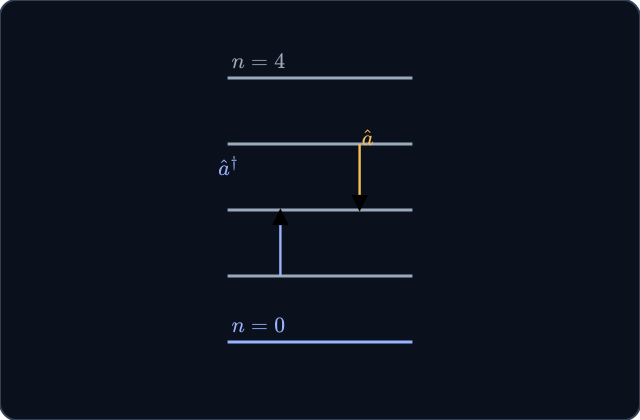
The ladder of levels, one quantum apart. The raising operator takes a state one rung up, adding ; the lowering operator takes it one rung down. On the bottom rung the lowering operator gives zero, and the ladder ends there.
Factorising the Hamiltonian
Two operators built from and , adjoints of each other. Their commutator is one, the Hamiltonian is their product plus half a quantum, and their commutators with the Hamiltonian make them step the energy down and up.
Properties
- : expanding the product, the cross terms give .
The Hamiltonian through the ladder operators
Multiply the two definitions, keeping the order of and . The squares give the two energies; the cross terms do not cancel, because the operators do not commute, and leave their commutator, which the canonical relation turns into minus half a quantum.
Proof steps
Multiply the definitions in this order.
The cross terms are : a commutator, not zero.
The canonical commutation relation.
Multiply through by .
The first two terms are the Hamiltonian; move the half quantum across.
Applications
Practice
Up One Rung
The commutator of the Hamiltonian with the raising operator is times the raising operator. So the raising operator turns a state of energy into one of energy .
Try it
A state has energy . What is the energy of ?
One Commutator
Everything about the ladder operators follows from their commutator, which is the number one: a consequence of the canonical commutation relation between and .
Try it
What number is ?
Not Observables
The lowering operator is not Hermitian: its adjoint is the raising operator, a different operator. Neither stands for a measurable quantity, but their sum and difference give back and .
Try it
is a Hermitian operator.
Back to \hat{x} and \hat{p}
Adding the two ladder operators gives position; subtracting them gives momentum.
Try it
Which combination of ladder operators is proportional to ?
Try it
A state has energy . What is the energy of , in units of , if it is not zero?
Try it
.
Try it
What is the number in ?
Final checkpoint
Try it
Where does the half quantum in come from?
Try it
A state has energy . What is in it?
Try it
Lowering can go on for ever: for every energy state, is again a nonzero state one quantum lower.
Completion
Lesson complete
Great work! You now know how to:
- define the raising and lowering operators
- factorise the oscillator Hamiltonian and find the half quantum
- use their commutators with to step between levels