Intuition
One thing is demanded of every convergent series: its terms must shrink to nothing. That gives a test which can only ever prove divergence, and using it the other way round is the most common mistake in the subject. What does characterise convergence is the Cauchy criterion applied to the partial sums, which becomes a statement about blocks of consecutive terms — and it needs no candidate sum, which is exactly why it can be used at all.
A journey that reaches a destination must have steps that shrink to nothing near the end. But steps shrinking to nothing is no guarantee of arrival: a walker whose steps halve in length arrives, and one whose steps are a metre, then half, then a third, then a quarter, walks forever. What matters is not the size of one step but the length of every stretch.
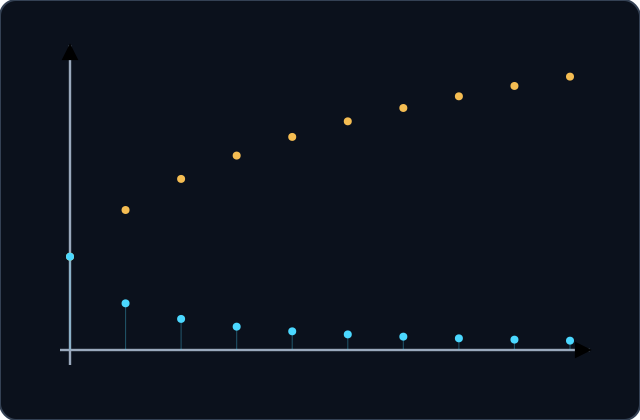
The terms of fall to zero and the running total keeps climbing. Terms tending to zero is necessary for convergence and never sufficient, and this is the picture of the gap between the two.
One necessary condition, and one that decides
If converges then ; the contrapositive is the term test, and it proves divergence only. The Cauchy criterion is the exact statement: converges if and only if for every there is an such that for all . It is the Cauchy condition on the partial sums, rewritten as a condition on blocks.
Using each one
- The term test proves divergence: if then diverges. It never proves convergence.
The terms of a convergent series tend to zero
The series is by definition the limit of its partial sums, so assume that limit exists and call it s. Each term is the difference between two consecutive partial sums, and both of those sequences converge to the same number — the second is the first with its index shifted, and shifting an index cannot change a limit. The algebra of limits then makes the difference tend to zero.
Proof steps
Convergence of the series is convergence of its partial sums.
A shifted sequence has the same limit, since a tail of one is a tail of the other.
Each term is the difference between two consecutive partial sums.
The algebra of limits applies to the difference of two convergent sequences.
Applications
Practice
A Test With One Direction
Terms tending to zero is necessary and not sufficient. The test can therefore only conclude divergence.
Try it
The terms of a series are known to tend to zero, and nothing else is known. What may be concluded?
Try it
Which series can be shown to diverge by the term test alone?
Try it
If then converges.
Blocks, Not Terms
The Cauchy criterion for sequences, applied to the partial sums, becomes a condition on consecutive blocks.
Try it
What does the Cauchy criterion say about ?
Try it
For , what is the value of the block , to two decimal places?
Try it
The term test is a special case of the Cauchy criterion.
Try it
The first ten terms of a convergent series are replaced by arbitrary numbers. What happens?
What You Learned
- A convergent series has terms tending to zero.
- The contrapositive is the term test; it proves divergence only.
- shows that the converse fails.
- The Cauchy criterion is a condition on blocks of terms and names no sum.
Final checkpoint
Try it
A student writes: ", so converges." What is wrong?
Try it
The Cauchy criterion for series requires a candidate sum to be named first.
Completion
Lesson complete
Great work! You now know how to:
- State the term test and use it in the one direction it runs
- Name the counterexample to its converse without hesitating
- Write the Cauchy criterion for a series as a condition on blocks
- Say why only the tail of a series decides convergence