Intuition
Every test so far has needed non-negative terms. The first test that does not is for series whose signs alternate strictly: if the sizes decrease to zero, the series converges, and the error after stopping is no larger than the first term left out. The proof is a picture — the partial sums step forward and back by ever smaller amounts, trapping the answer between them — and it is the nested interval property doing the work.
A man walks a metre east, half a metre west, a third of a metre east, and so on. Each correction overshoots the last position and each is smaller than the one before, so he is always between his last two positions, and those close in on a single point. He never stands still and he never escapes.
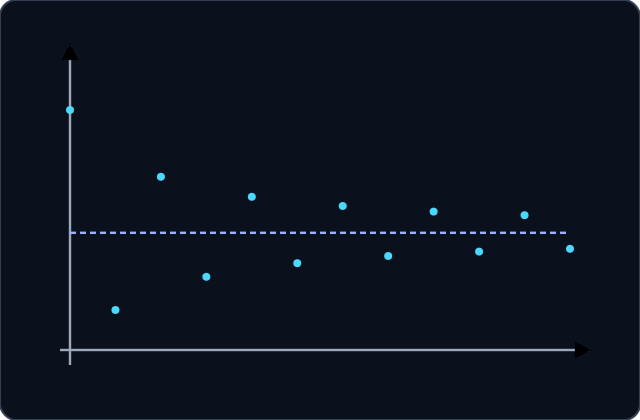
The running totals of step above and below the level they settle at, each step shorter than the last. Every odd total is above the answer and every even one below, so stopping anywhere gives an error no larger than the next term.
The test, and the error it comes with
Let with decreasing and . Then converges, and if is its sum then . Both hypotheses are needed: the sizes must decrease, not merely tend to zero, and they must tend to zero at all. The error bound is unusual — most tests prove convergence and say nothing about how far a partial sum is from the answer.
Using it, and its limits
- The odd partial sums decrease, the even ones increase, and every even one is below every odd one; the sum is trapped between consecutive partial sums.
- : the error is at most the first term omitted, which makes the test a practical way to compute a sum.
The alternating series test
Look at the two halves of the sequence of partial sums separately. Grouping the terms in pairs shows that the even-indexed partial sums increase and the odd-indexed ones decrease, and each even one stays below each odd one. The intervals between them are therefore nested and closed, and their lengths are the terms, which shrink to nothing — so they close on a single point, and both halves converge to it.
Proof steps
Group the next two terms: the sizes decrease, so the even partial sums increase.
The same grouping on the other half: the odd partial sums decrease.
Their difference is a single positive term, so each even one lies below the odd one after it.
Closed bounded intervals, each inside the last, with lengths shrinking to nothing.
They close on one point, which both halves converge to; and the answer never leaves the current bracket.
Applications
Practice
Two Hypotheses, Both Needed
The sizes must decrease and must tend to zero. Neither on its own is enough.
Try it
What does the alternating series test require of the sizes of the terms?
Try it
For , how many terms are needed so that the error is at most ?
Try it
It is enough for the sizes of the terms to tend to zero for an alternating series to converge.
Try it
Which series converges by the alternating series test?
The Answer Is Always in the Bracket
Consecutive partial sums straddle the sum, so each one is an estimate with a known error.
Try it
For a convergent alternating series with decreasing sizes, where does the sum lie?
Try it
converges and diverges.
Try it
Does the test apply to , where the signs come in pairs?
What You Learned
- Alternating signs with sizes decreasing to zero give convergence.
- Consecutive partial sums bracket the sum, and the error is at most the next term.
- Both hypotheses on the sizes are needed.
- The alternating harmonic series converges while the harmonic series does not.
Final checkpoint
Try it
An alternating series with decreasing sizes is stopped after terms. What bounds the error?
Try it
A series that converges by the alternating series test also converges when every term is replaced by its size.
Completion
Lesson complete
Great work! You now know how to:
- State both hypotheses of the alternating series test
- Use the error bound to compute a sum to a stated accuracy
- Say why the partial sums bracket the answer
- Give a series that converges only because of its signs