Intuition
An infinite series is not a sum of infinitely many numbers, because adding is an operation on two things at a time. It is the limit of the finite sums. That single sentence hands the whole of the previous chapter over: a series is a sequence wearing different notation, and every question about it is a question about that sequence.
You never add infinitely many things. You watch the running total and ask where it settles. The series is the destination of the running total, not an act of addition performed all at once.
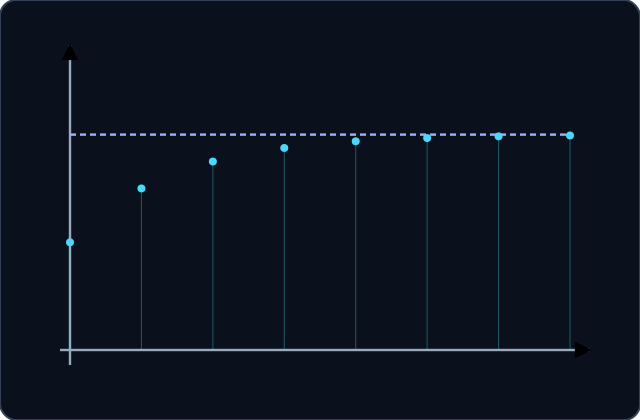
The dots are not the terms of but its running totals . Nobody adds infinitely many numbers; you watch where the totals go, and the series is that destination — 1. Every question about the series is now a question about this ordinary sequence.
Partial sums
Attach to the terms the sequence of their running totals. The series is defined to be the limit of that sequence, so convergence of a series means nothing more or less than convergence of the partial sums.
What follows immediately
- is the -th partial sum, and the series is the sequence .
Powers of a small number tend to zero
The powers fall and stay above zero, so the previous chapter guarantees a limit without saying what it is. Shifting the sequence by one place gives a second expression for that same limit, and the two together leave only zero.
Proof steps
Multiplying by a number under one makes each term smaller, and powers of a positive number stay positive.
The theorem gives a limit without any formula for it, which is exactly what is needed here.
Dropping one term from the front changes no limit.
The algebra of limits handles the constant factor.
A limit is unique, so the two expressions for it are equal.
Since is below one the other factor cannot vanish.
Applications
Practice
A series is a limit
Everything asked of a series is asked of the sequence on the right.
Try it
What does mean?
Terms must vanish, but that is not enough
has and does not converge.
Grouping the terms into blocks each summing to at least a half shows the totals grow without bound.
Try it
The terms of a series tend to zero. What follows?
Using the condition backwards
diverges because its terms do not tend to zero.
The terms keep their size for ever, so the partial sums cannot settle.
Try it
Which series can be ruled out as convergent immediately?
The geometric series
Each step covers half the remaining distance to two.
Try it
What is ?
Try it
For which ratio does diverge?
A Series Is a Sequence
Everything proved about sequences applies, once the sequence in question is named as the partial sums.
Try it
Which sequence decides whether converges?
Try it
For starting at , what is the partial sum ?
Try it
If and both converge then converges to the product of the two sums.
What You Learned
- A series is the limit of its partial sums, not a sum of infinitely many numbers.
- It converges exactly when that sequence of partial sums converges.
- Series add and scale like limits do.
- The terms tending to zero is necessary and never sufficient.
Final checkpoint
Try it
Why is defined as a limit rather than as a sum?
Completion
Lesson complete
Great work! You now know how to:
- Say what an infinite series is, and what decides its convergence
- Compute partial sums and read a series as a sequence
- Add and scale convergent series, and say why products are different