Intuition
A series of non-negative terms converges exactly when its partial sums stay bounded, and the simplest way to bound them is by another series already known to converge. That is the comparison test. Its limit form removes the need for a term-by-term inequality: if two series have terms of comparable size in the long run, they live or die together, and comparability is all that most examples can be made to show.
To prove a stack of coins is short, stand it beside a stack known to be short and check that each coin is thinner. If the coins are not individually thinner but are all within a fixed factor of the same thickness, the two stacks are still within a fixed factor of each other in height — which settles the question just as well.
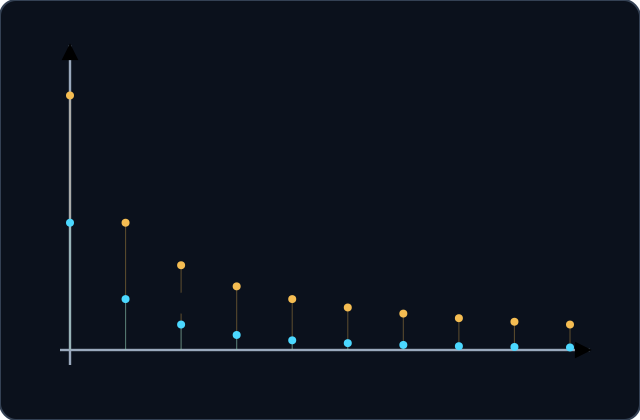
Every term of the lower sequence is at most the matching term of the upper one, so every partial sum is too. Convergence therefore passes downwards, and divergence upwards — and neither passes the other way.
Two tests, and the family they are used with
Comparison: if for every and converges, then converges; if diverges, then diverges. Limit comparison: if and with , the two series converge or diverge together. Both are used against the family , which converges exactly when .
What to watch
- Both tests need non-negative terms. With mixed signs the partial sums can fall as well as rise, and the bounded criterion they rest on is unavailable.
- The inequality need only hold from some index on, since finitely many terms do not affect convergence.
- The limit form is the one to use when the terms are quotients of polynomials: compare with the ratio of the leading powers.
- If then convergence of still gives convergence of , but divergence of gives nothing.
The comparison test
Everything is done with partial sums. Adding the term-by-term inequality over the first n indices bounds one partial sum by the other, and the larger series, being convergent with non-negative terms, has partial sums bounded by its own total. So the smaller partial sums are increasing and bounded above, and the criterion of the previous lesson finishes the argument without any tolerance being named.
Proof steps
Name the two sequences of partial sums.
Adding an inequality over the first n indices keeps it.
The larger series has non-negative terms, so its partial sums increase to its total and never pass it.
The smaller partial sums increase because its terms are non-negative, and they are bounded by the same number.
An increasing sequence bounded above converges, which is the criterion of the previous lesson.
Applications
Practice
Which Way Each Conclusion Runs
Convergence passes to the smaller series; divergence passes to the larger.
- converges converges
Try it
and converges. What follows about ?
Try it
Which comparison settles ?
Try it
The comparison test works for series with terms of any sign.
Comparable Is Enough
A finite non-zero limit of the quotient means the two series are within a fixed factor of each other in the long run.
Try it
with all terms positive, and diverges. What follows?
Try it
Which series is the natural comparison for ?
Try it
The inequality must hold for every index for the comparison test to apply.
Try it
For which integer values of from to does converge? Give how many of them.
What You Learned
- Comparison needs non-negative terms and an inequality holding from some index on.
- Convergence passes down the inequality and divergence passes up.
- The limit form needs only a finite non-zero quotient limit.
- converges exactly when , and chapter eight proves it in general.
Final checkpoint
Try it
Which series diverges?
Try it
If and diverges, then diverges.
Completion
Lesson complete
Great work! You now know how to:
- Apply the comparison test in the direction each conclusion runs
- Choose a comparison series by the leading powers
- Use the limit form when no term-by-term inequality is available
- State the condition on for