Intuition
One family of series can be summed exactly, and it is the family every test in this chapter measures others against. The terms of a geometric series are each a fixed multiple of the one before, and the partial sums have a closed form found by a trick worth remembering: multiply the sum by the ratio and subtract, and almost everything cancels.
A bouncing ball rising to a fixed fraction of its previous height travels a finite total distance, although it bounces infinitely often. The fraction is the ratio, and whether the total is finite depends on it alone — not on how high the first bounce was.
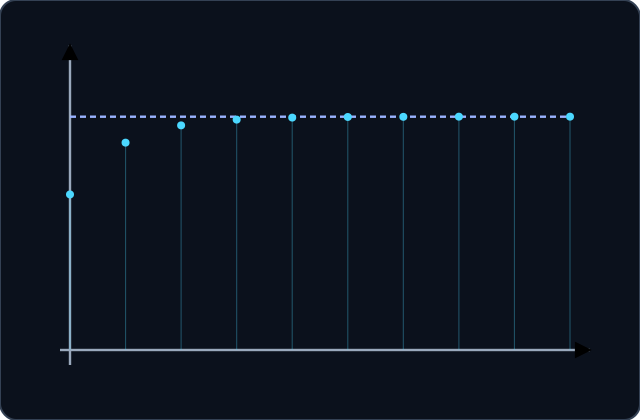
The running totals of climb towards the level and never reach it. The closed form explains both facts at once: the correction shrinks to nothing and is never zero.
The closed form, and what it decides
For the partial sums of are , where counts the terms. When the power tends to zero, so the series converges to ; when the terms do not tend to zero and the series diverges by the term test. The starting index only changes the numerator: a series beginning at sums to .
The facts worth memorising
- converges exactly when , and then to .
The sum of a geometric series
Find the partial sums exactly and then take their limit. Multiplying a partial sum by the ratio produces almost the same sum shifted by one place, so subtracting leaves only the two end terms; dividing by one minus the ratio gives the closed form, which is legitimate because the ratio is not one. Then use the fact that a power of a number smaller than one in size tends to zero, and the algebra of limits does the rest.
Proof steps
Write down the partial sum with n terms.
Multiply by the ratio: the same terms, shifted one place along.
Subtract; everything in the middle cancels and only the ends survive.
Divide by one minus the ratio, which is not zero because the ratio is not one.
A power of a number smaller than one in size shrinks to nothing.
The algebra of limits applied to the closed form finishes it.
Applications
Practice
First Term Over One Minus the Ratio
The closed form is easiest remembered in that shape, because it covers every starting index at once.
Try it
What is ?
Try it
For which ratio does converge?
Try it
What is ?
Try it
is strictly less than .
Multiply and Subtract
The closed form is found by producing the same sum shifted one place and subtracting.
Try it
Why does multiplying the partial sum by and subtracting help?
Try it
The closed form is valid for every ratio .
Try it
A ball is dropped from metres and each bounce reaches of the previous height. What is the total vertical distance travelled?
What You Learned
- A geometric series converges exactly when .
- Its sum is the first term divided by one minus the ratio.
- The closed form comes from multiplying by the ratio and subtracting.
- Every repeating decimal is a geometric series, and every test in this chapter compares against this family.
Final checkpoint
Try it
What is ?
Try it
A geometric series with a negative ratio cannot converge.
Completion
Lesson complete
Great work! You now know how to:
- State when a geometric series converges and to what
- Derive the closed form by multiplying and subtracting
- Sum a geometric series that starts at any index
- Turn a repeating decimal into a fraction