Intuition
When no term is negative the partial sums can only rise. A rising sequence has just two possible fates: it passes every bound, or it settles. That reduces a question about a series to a question about whether one number can be found above all the running totals, which is often far easier to answer.
Water poured into a tall glass, never removed. Either it overflows or it reaches a level. Nothing else can happen, and knowing the glass has a rim is enough to know a level is reached.
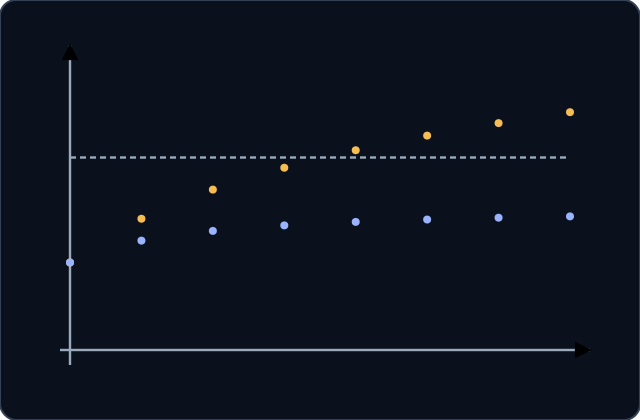
With no negative term the running totals can only rise, which leaves exactly two fates. The totals of stay under the rim and therefore settle; those of climb past that rim and past every other one you draw. Bounded above is the whole of the question.
The bounded partial sums criterion
This is the monotone convergence theorem read for series. It is the workhorse of the chapter, and every later test reduces to it by comparison.
What it gives
- For non-negative terms the partial sums are increasing, so only two fates remain: they pass every bound, or they settle.
- So with converges exactly when its partial sums are bounded above, and then the sum is their supremum.
Non-negative series converge exactly when bounded
Non-negative terms make the partial sums increasing, and an increasing sequence converges precisely when it is bounded above. Each direction is one theorem from the previous chapter.
Proof steps
Each new term can only add, never take away.
This is the monotone convergence theorem, applied to the partial sums.
Every convergent sequence is bounded, which was proved in the previous chapter.
Each implies the other, which is what the statement claims.
Applications
Practice
Only two fates
Each new term adds something non-negative, so the totals cannot go back down.
Try it
A series has non-negative terms and bounded partial sums. What follows?
The sign condition is not decorative
has bounded partial sums and does not converge.
The totals alternate between two values, staying bounded without ever settling.
Try it
A series has bounded partial sums but terms of both signs. Does it converge?
Try it
Which theorem from the previous chapter does this criterion rest on?
Blocks That Never Shrink
Group the harmonic series into blocks of doubling length. Each block has more terms as it goes, and they shrink at exactly the rate that keeps each total the same.
Try it
Why does grouping show that diverges?
Try it
Grouping the harmonic series shows . What is the smallest for which that bound guarantees ?
Try it
Brackets may be inserted freely into any convergent series without changing its sum.
Try it
A series of non-negative terms has partial sums , each with one more nine than the one before. What is its sum?
Try it
A series of non-negative terms either converges or has partial sums passing every bound.
What You Learned
- Non-negative terms make the partial sums increase, leaving only two fates.
- Such a series converges exactly when its partial sums are bounded above.
- The criterion rests on monotone convergence and so on completeness.
- Grouping the harmonic series into doubling blocks shows it diverges.
Final checkpoint
Try it
A series of non-negative terms has partial sums that never exceed . What follows?
Completion
Lesson complete
Great work! You now know how to:
- State the bounded partial sums criterion and name the theorem behind it
- Prove that the harmonic series diverges by grouping
- Say why non-negative terms are needed for any of this