Intuition
Both tests ask the same question: does the series eventually behave like a geometric one? The ratio test compares each term with the one before, the root test looks at the size of the terms directly. If either says the effective ratio settles below one, the series is squeezed under a convergent geometric series and converges absolutely. If it settles above one the terms do not even vanish. At exactly one, both tests say nothing at all.
Both are asking how fast the terms shrink, and comparing that with a geometric decay that is known to be safe. A rate under one is shrinking fast enough; above one is not shrinking at all. Exactly one is a tie, and a tie carries no information.
Two tests, one idea
These are stated for the case where the limit exists, which covers everything met in practice. Sharper versions replace the limit by the limit of the suprema of the tails and apply more widely; the reasoning is unchanged.
Reading the result
- Ratio test: with the limit of , the series converges absolutely if and diverges if .
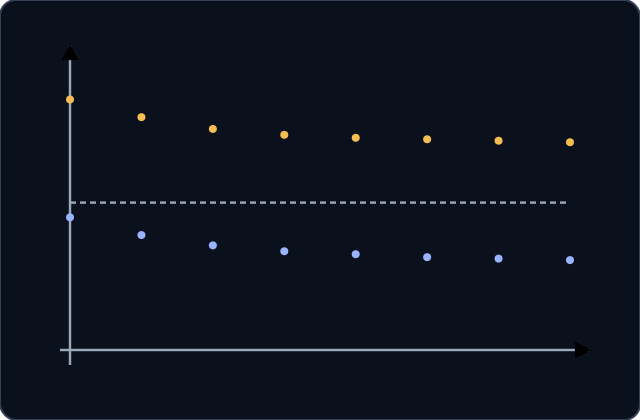
Both tests measure one number: the level the ratios settle at. Settle below 1 and the terms are squeezed under a convergent geometric series; settle above it and they do not even shrink to zero. At exactly 1 — the line itself — neither test says anything at all.
The ratio test
Choose a number between the limit and one. Beyond some place every ratio is under it, so the terms shrink at least as fast as its powers. A geometric series then bounds the tail, and comparison finishes it.
Proof steps
There is room between the limit and one, and that room is what the proof spends.
The ratios settle at , so eventually they stay under anything above it.
Each step multiplies by less than , so steps multiply by less than its -th power.
Its ratio has size below one, which is the case settled two lessons ago.
The tail is dominated by a convergent series, and the finitely many earlier terms cannot spoil that.
Applications
Practice
Below one means convergence
gives
The ratio settles below one, so the series converges absolutely.
Try it
The ratio limit for a series is . What follows?
Above one means the terms grow
gives
Each term is twice the last, so the terms run away and the series diverges.
Try it
The ratio limit for a series is . What follows?
At one the test is silent
and both give
The first diverges and the second converges, so the value one cannot decide either way.
Try it
The ratio limit is exactly . What follows?
The geometric series is the yardstick
The tail is trapped under a geometric series with ratio under one.
Try it
Which series does the ratio test compare against?
Try it
What quantity does the root test take the limit of?
Both Are the Geometric Comparison
Each test asks whether the terms are eventually dominated by a geometric sequence with ratio below one.
Try it
Which statement about the two tests is true?
Try it
For , what is ?
Try it
If the ratio limit is exactly the series diverges.
What You Learned
- Both tests compare a series with a geometric one and test absolute convergence.
- Below one gives convergence, above one divergence, and at exactly one neither decides.
- The root test is the stronger and is stated with an upper limit.
- Neither settles a series behaving like .
Final checkpoint
Try it
Which series is settled by the ratio test?
Completion
Lesson complete
Great work! You now know how to:
- Apply the ratio and root tests and read their three cases
- Say why the root test is the stronger
- Recognise the series neither test can settle