Intuition
A set is bounded above when some number is at least as large as everything in it. That number is called an upper bound, and it need not belong to the set. A set that has one upper bound has infinitely many, since anything larger works just as well.
A ceiling is above every point in a room, and so is the roof, and so is the sky. None of them is in the room. Saying a room has a ceiling is not the same as pointing to its highest point.
Bounds of a set
Let S be a set of real numbers. The definitions below say nothing about whether the bound belongs to S, and that silence is deliberate: the next lesson is about the best bound, which often does not.
Points to hold on to
- An upper bound need not lie in the set. For , the number bounds above and is not in it.
- Anything above an upper bound is also an upper bound, so bounds never come singly.
- A lower bound is defined the same way with the inequality reversed.
- A set is bounded when it is bounded above and below. The empty set is bounded, vacuously.
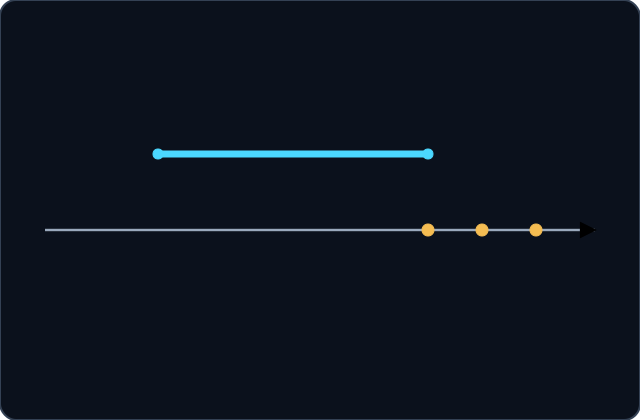
Nothing in is above 2, so 2 bounds it above — and so do 3 and 4 and everything to their right. An upper bound need not belong to the set, and a set with one bound has infinitely many.
Bounds never come singly
Take any member of the set. It sits below the first bound, which sits below the second, so it sits below the second. Since the member was arbitrary, the second number bounds the whole set.
Proof steps
Nothing will be assumed about beyond its membership.
This is what it means for to bound the set above.
This is the assumption about the second number.
Two inequalities in the same direction chain together.
The member was never named, so the conclusion covers every member at once.
Applications
Practice
A bound need not belong
For , the number bounds above.
Every member is below one, and one is not a member. Both facts hold at once.
Try it
Must an upper bound of a set belong to that set?
One bound brings infinitely many
For , each of bounds above.
Three is the smallest such number, but nothing in the definition asks for the smallest.
Try it
How many upper bounds does have?
Some sets have no upper bound
has no upper bound.
Whatever number is proposed, adding one to it produces a natural number that is larger.
Try it
Which of these sets is not bounded above?
Lower bounds mirror upper ones
For , the number bounds below.
Every member exceeds two, and two is not itself a member.
Try it
Which number is a lower bound of ?
Try it
What does it mean for a set to be bounded?
Bounded in One Line
Two bounds can be replaced by one, by bounding the size instead of the number.
Try it
Which condition says that is bounded?
Try it
The empty set is bounded above.
Try it
What is the smallest integer that bounds above?
Try it
Which set is bounded above but not below?
What You Learned
- An upper bound need not belong to the set, and bounds never come singly.
- Bounded means bounded above and below, which is one condition on .
- The empty set is bounded, vacuously.
- A finite non-empty set contains its own largest and smallest elements.
Final checkpoint
Try it
If a set has an upper bound that belongs to it, that bound is its largest element.
Completion
Lesson complete
Great work! You now know how to:
- Recognise upper and lower bounds and say why they never come singly
- State boundedness as one condition on the absolute value
- Handle the empty set correctly