Intuition
Completeness has been assumed; now it starts paying. The first thing it buys is a fact that looks too obvious to need a proof: no real number is larger than every natural number. It needs one because nothing said so far forbids a number sitting above the whole of the naturals — an ordered field can have such elements — and completeness is exactly what rules them out.
A staircase with steps of equal height reaches any ceiling, however high, provided the steps keep coming. The claim is not that some particular step is high enough; it is that no ceiling can outrun the whole staircase. Completeness is what stops a ceiling hanging just above every step at once.
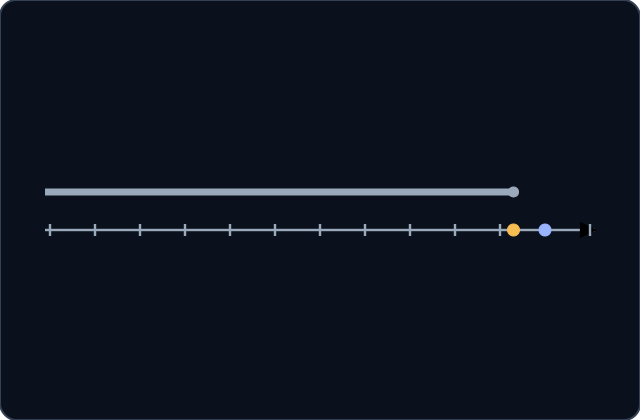
However far out lies, some natural number is past it. The proof does not find that by counting; it shows that a real number above every natural would force the naturals to have a least upper bound, and then walks back one step from that bound to reach a contradiction.
Three ways to say the same thing
The Archimedean property states that for every real there is a natural with . Two rewritings are used constantly: for every there is a natural with , and for every positive and there is a natural with . Each follows from the first by dividing, and each is the form in which the property appears in a later proof.
Where each form is used
- : apply the property to . This is the form that makes in chapter four.
The Archimedean property
Suppose the claim fails. Then some real number bounds the whole of the naturals above, so by completeness the naturals have a least upper bound. Step back from that bound by one: the result is smaller, so it is not an upper bound, so some natural number beats it — and adding one to that natural number produces a natural number above the least upper bound itself. That is impossible, so the supposition fails.
Proof steps
Assume the denial: some real number bounds the naturals above.
The naturals are non-empty and bounded above, so completeness supplies a least upper bound.
Anything below the least upper bound fails to be an upper bound.
Add one to both sides; the result is still a natural number.
A natural number above the supremum of the naturals is impossible, so the supposition was false.
Applications
Practice
No Real Sits Above Them All
The property is a statement about the naturals as a whole, not about any particular one.
Try it
What does the Archimedean property say?
Try it
Given , which form of the property produces a natural with ?
Try it
What is the smallest natural number with ?
Try it
The Archimedean property follows from the order axioms alone, without completeness.
Step Back From the Bound
The one move a least upper bound allows: anything below it is not an upper bound, so something in the set beats it.
Try it
In the proof, why is there a natural number with ?
Try it
Every real number lies in for exactly one integer .
Try it
A step of size is taken repeatedly from . Which form of the property says the walk passes the target ?
What You Learned
- No real number is at or above every natural number.
- Equivalent forms: some is below any given tolerance, and steps of any fixed size pass any target.
- The proof spends completeness, and the property fails in ordered fields that are not complete.
- It is the tool that picks the N in every epsilon–N proof.
Final checkpoint
Try it
Which statement is a direct consequence of the Archimedean property?
Try it
The Archimedean property names a particular natural number that works for every real .
Completion
Lesson complete
Great work! You now know how to:
- State the Archimedean property and its two working forms
- Produce an n making a reciprocal smaller than a given tolerance
- Say which step of the proof spends completeness
- Keep the order of the quantifiers straight