Intuition
Among all the upper bounds of a set, one may be smaller than every other. That least upper bound is called the supremum, and it is the sharpest ceiling the set admits. It sometimes belongs to the set and sometimes does not, which is exactly why it succeeds where the notion of a largest member fails.
A crowd presses towards a wall without anyone touching it. There is no closest person, since whoever you name, someone stands nearer. The wall itself is still the sharpest line beyond which nobody stands.
The least upper bound
Two conditions define it. The supremum must bound the set above, and no smaller number may do so. The second condition is what makes it least, and it is usually the one that has to be checked.
How to recognise one
- is an upper bound: every member lies at or below it.
- No number below is an upper bound, so anything smaller is beaten by some member.
- For the supremum is , which is not a member. There is no largest member at all.
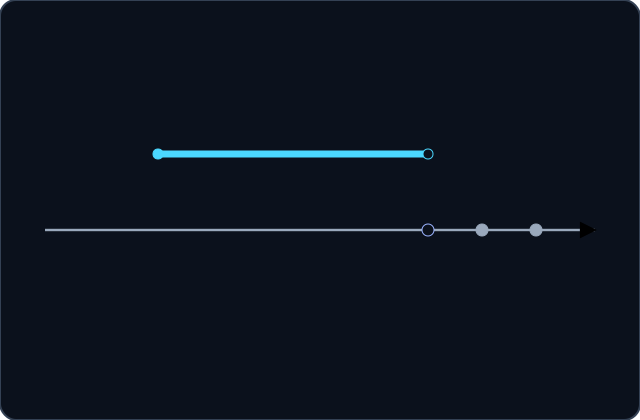
Of all those bounds one lies furthest left, and that least one is the supremum. Here stops short of 2 and all the same — the hollow mark is the point of the definition: the sharpest ceiling need not be a member.
A set has at most one supremum
Each candidate is an upper bound, and each is least among upper bounds. Playing those two facts against each other traps the pair between two inequalities that leave only equality.
Proof steps
Assume two of them exist, then show they cannot differ.
Being least means being no larger than any other upper bound.
The same argument with the two swapped.
Both inequalities hold at once.
Two numbers each at most the other are the same number.
Applications
Practice
The supremum may sit outside
Every member is below one, nothing smaller bounds the set, and one is not a member.
Try it
What is the supremum of ?
Supremum against maximum
has and no maximum.
Name any member and one halfway to one is larger, so no member is largest.
Try it
Which set has a supremum but no maximum?
The second condition does the work
bounds above but is not its supremum.
Two also bounds the set, and two is smaller, so ten was not least.
Try it
Why is not the supremum of ?
The infimum mirrors it
Three sits below every member, nothing larger does, and three is not itself a member.
Try it
What is the infimum of ?
Try it
Can a set have two different suprema?
The Form That Gets Used
Leastness is almost always applied in this shape: pick a tolerance, and find a member of the set within it.
Try it
Let and let . What does leastness guarantee?
Try it
If a set has a largest element then that element is its supremum.
Try it
What is ?
Try it
What is ?
What You Learned
- The supremum is the least upper bound, and a set has at most one.
- It need not belong to the set; when it does, it is the maximum.
- Leastness in use: for any some element exceeds .
- Infima mirror suprema exactly, via .
Final checkpoint
Try it
A non-empty set of reals that is bounded above always has a largest element.
Completion
Lesson complete
Great work! You now know how to:
- State the two conditions defining a supremum
- Use leastness in its form
- Tell a supremum from a maximum, and give a set with one and not the other
- Mirror every statement about suprema into one about infima