Intuition
An interval is a stretch of the line with no holes in it, and almost every set this course talks about is one. What decides an interval is not its length but whether it keeps its own endpoints, and that single distinction runs through the rest of the course: a closed interval has a largest element and an open one does not, a continuous function on a closed interval attains its maximum and on an open one may not.
A platform runs from one end of the station to the other. Whether the last tile at each end counts as platform makes no difference to how far you can walk, but it makes every difference to whether there is a last place to stand. Most of the theorems in this course are about whether there is a last place to stand.
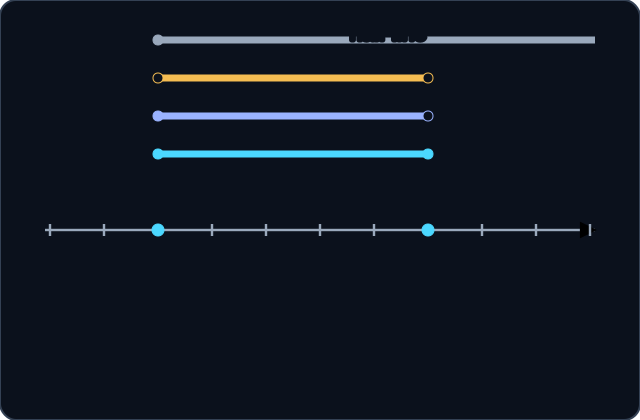
The same two endpoints give , which contains both, , which keeps one, and , which contains neither; a hollow end is a value the stretch reaches towards and stops short of. An unbounded interval such as has only one endpoint and runs on past the picture: is not a number it could contain.
The nine shapes, and what makes them one family
For the bounded intervals are , , and , and the unbounded ones are , , , and . A square bracket includes the endpoint, a round one excludes it, and a bracket at is always round because there is no number there to include. What all nine have in common is convexity: if two numbers lie in the set, everything between them does too.
Reading and using them
- is an interval exactly when and force . Every set with that property is one of the nine shapes.
A tolerance is an interval
The absolute value is defined by two cases, so unpack it in each and see what the condition says about x. Both cases give one half of a pair of inequalities, and putting them together is the interval. The direction back is the same reading in reverse, which is why the two conditions are interchangeable wherever either appears — and they appear in every definition from the fourth chapter on.
Proof steps
Start from the statement about distance.
A number has absolute value below a bound exactly when it lies between that bound and its negative.
Add c throughout, which an inequality allows.
Which is membership in the open interval centred at c with radius delta.
Applications
Practice
A Bracket Is a Decision About One Point
Square includes the endpoint, round excludes it. The bracket at infinity is always round.
Try it
Which set is ?
Try it
Which interval is ?
Try it
What is the length of the interval ?
Try it
The union of two intervals is always an interval.
What Makes a Set an Interval
Not its shape or its length, but that it has no holes: anything between two of its points belongs to it.
Try it
Which set is an interval?
Try it
has exactly one element and has none.
Try it
What is ?
Try it
How many integers lie in the interval ?
What You Learned
- Square brackets include an endpoint, round ones exclude it, and a bracket at infinity is always round.
- is the open interval centred at c with radius delta.
- A set is an interval exactly when it contains everything between any two of its points.
- An intersection of intervals is an interval or empty; a union need not be either.
Final checkpoint
Try it
Which of these sets has a largest element?
Try it
Writing would be a mistake.
Completion
Lesson complete
Great work! You now know how to:
- Read the four bounded and five unbounded shapes off their brackets
- Turn into an interval and back
- Say what makes a set an interval, and give a set that is not one
- Tell an interval with a largest element from one without