Intuition
The real numbers come with an order, and that order behaves well under addition but needs care under multiplication: multiplying an inequality by a negative number turns it around. Absolute value measures distance from zero, which turns questions about nearness into inequalities.
Reading a thermometer, minus ten is colder than minus three even though ten is the larger number. The order on the negatives runs against the size, which is exactly what multiplying by a negative does to an inequality.
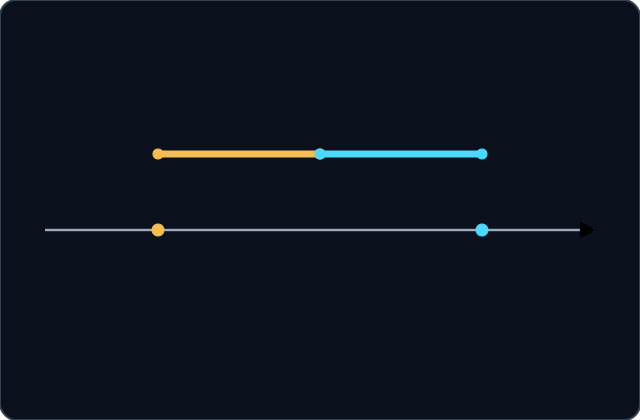
Absolute value forgets the side and keeps the distance, so and are both 3. That is what lets be read as " is within of ", which is how nearness is written for the rest of the course.
Order and distance
The absolute value of a number is its distance from zero, so the distance between two numbers is the absolute value of their difference. Almost every statement in analysis is eventually an inequality between such distances.
Rules worth knowing by heart
- Adding the same number to both sides preserves an inequality.
- Multiplying both sides by a positive number preserves it; by a negative number it reverses.
- is the distance between and .
- says exactly .
The triangle inequality
Each number lies between the negative and the positive of its own absolute value. Adding those two statements traps the sum in the same way, and being trapped is what an absolute value bound means.
Proof steps
A number never exceeds its absolute value, nor falls below its negative.
The same holds for the second number.
Adding two inequalities of the same direction keeps that direction.
Being trapped between and is precisely what an absolute value at most means.
Applications
Practice
A negative factor turns it around
Multiplying by minus one flipped the sign, and the larger number became the smaller.
Try it
From , what follows when both sides are multiplied by ?
Absolute value is a distance
says lies within of .
That is the interval from to , not counting the ends.
Try it
Which set of numbers does describe?
Unpacking an absolute value bound
The single condition becomes a pair, which is usually far easier to work with.
Try it
Which pair of inequalities is equivalent to ?
Bounding a sum
Equality holds when the two point the same way; otherwise the left side is strictly smaller.
Try it
Given and , what can be said about ?
Try it
From , which statement always follows?
Adding Through a Middle Point
The triangle inequality is usually used with a term inserted and subtracted, so that one distance becomes two.
Try it
Which inequality follows from the triangle inequality for any ?
Try it
Given , what does the reverse triangle inequality give?
Try it
If then .
Try it
How many integers satisfy ?
What You Learned
- Adding to both sides preserves an inequality; multiplying by a negative reverses it.
- is the distance from x to y, and is .
Final checkpoint
Try it
From it follows that .
Completion
Lesson complete
Great work! You now know how to:
- Manipulate an inequality, reversing it when multiplying by a negative
- Read an absolute value as a distance and unpack it into two inequalities
- Use the triangle inequality by inserting a middle point