Intuition
A second face of completeness closes this chapter. Take a closed interval, then a closed interval inside it, then another inside that, forever. The nested interval property says something is left: at least one point belongs to every one of them. It is completeness in a form that can be used directly, and it is the engine of the bisection arguments that prove three of the largest theorems in this course.
A search narrows a stretch of coastline by half at each step, always keeping a stretch that still contains the wreck. Each stage is shorter and none is ever empty, so the search converges on a place. What the property guarantees is that the place exists — that the shrinking did not close on a gap.
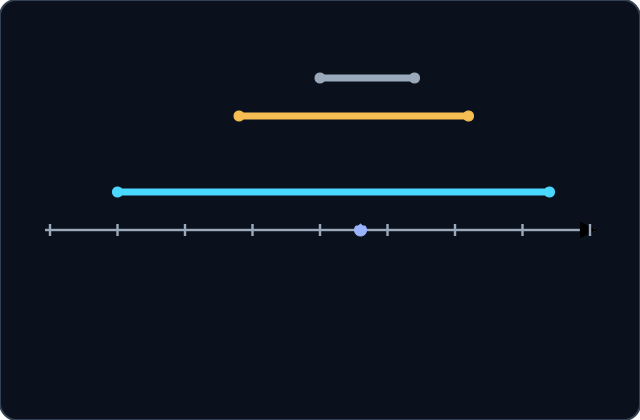
Each closed interval contains the next, and lies in all of them. The point is not constructed by following the shrinking; it is the supremum of the left endpoints, and completeness is what says that supremum exists.
The property, and the two conditions it needs
Let be closed bounded intervals with . Then is not empty. Both conditions are needed: the intervals must be closed, and they must be bounded. If in addition the lengths can be made as small as one likes, the intersection holds exactly one point.
Where it fails, and what it gives
- Open intervals are not enough: , although every one of them is non-empty and each contains the next.
Nested closed intervals share a point
The point is not chased down the nest; it is produced in one move. Nesting makes the left endpoints increase and the right ones decrease, and it forces every left endpoint to sit below every right endpoint — including ones from far later stages. So the set of left endpoints is bounded above by each right endpoint, and completeness hands over its supremum. That supremum is above every left endpoint by definition, and below every right endpoint because each of those is an upper bound and the supremum is the least one.
Proof steps
Nesting says each interval sits inside the one before, so the left ends move right and the right ends move left.
Take k above both n and m: then a_n <= a_k <= b_k <= b_m, so every left endpoint is below every right endpoint.
The left endpoints form a non-empty set bounded above, so completeness gives it a least upper bound.
The supremum is an upper bound of the left endpoints.
Each right endpoint is an upper bound of A, and the supremum is the least of them.
So x lies in every interval, and the intersection is not empty.
Applications
Practice
Closed, and Bounded
Both conditions do work. Drop either and the common point can vanish.
Try it
Why does the nested interval property insist the intervals be closed?
Try it
Which of these intersections is empty?
Try it
If the lengths can be made as small as one likes, the nest has exactly one common point.
Try it
Which step of the proof uses completeness?
Try it
An interval of length is halved repeatedly. After how many halvings is its length first below ?
Try it
The nested interval property holds in as well as in .
Why Bisection Works
Halving an interval and keeping the half where the property survives builds a nest automatically, and the nest hands back a point.
Try it
A bisection argument halves an interval repeatedly and keeps one half each time. What does the nested interval property supply at the end?
What You Learned
- Nested closed bounded intervals always share a point.
- Open ends or unbounded intervals can leave the intersection empty.
- Lengths shrinking to zero make the common point unique.
- The proof is one application of completeness, to the set of left endpoints.
Final checkpoint
Try it
is empty.
Try it
Which nest is guaranteed by the property to have a common point?
Completion
Lesson complete
Great work! You now know how to:
- State the nested interval property with both of its conditions
- Give a nest with empty intersection for each condition dropped
- Point to the single step of the proof that spends completeness
- Say what a bisection argument gets out of it