Intuition
Continuity lets the radius be chosen afresh at each point. Uniform continuity demands one radius that serves the whole domain at once. The difference is a swap of two quantifiers, and it is a real difference: some continuous functions need ever smaller radii as they move about their domain, and have no single one. The theorem of this lesson is that on a closed bounded interval the difficulty cannot arise.
A guarantee about a machine can be given per setting — at each dial position, some accuracy suffices — or once for the whole range: this accuracy suffices wherever the dial is. The second is a stronger promise and is not always available. What this lesson says is that on a closed bounded range it always is.
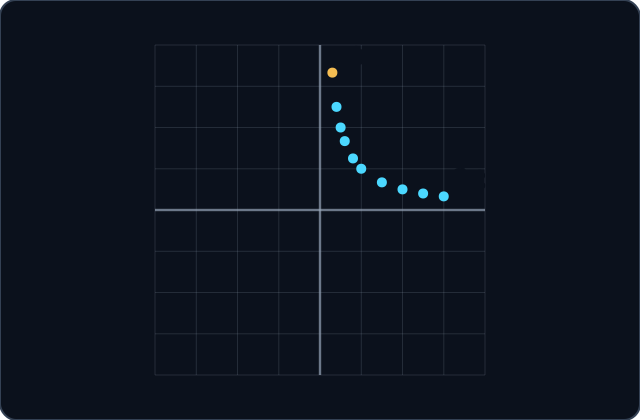
The dots trace . Near the left the values change violently over a short stretch of inputs, so a tolerance that a large radius answers out to the right needs a tiny one here — and no single radius answers it everywhere.
One radius for the whole domain
is uniformly continuous on when for every there is a such that for all with . Compare continuity on , where the points are quantified before the radius. Uniform continuity implies continuity and not conversely; the Heine–Cantor theorem says the two coincide on a closed bounded interval.
Where it holds and where it fails
- The quantifier order is the whole difference: continuity is , uniform continuity is .
- on and on are continuous and not uniformly continuous; both fail because the function steepens without limit.
Heine–Cantor
Suppose not. Then some tolerance defeats every radius, so taking the radii one over n in turn produces two sequences of points, ever closer together, whose values stay that tolerance apart. Both sequences live in a closed bounded interval, so Bolzano–Weierstrass gives a convergent subsequence of the first, and the second is dragged to the same limit because the gap between them shrinks. Continuity at that common limit makes both sequences of values converge to the same number, so their difference tends to zero — contradicting that it never fell below the tolerance.
Proof steps
Suppose uniform continuity fails and write the denial.
Take the radii one over n and choose an offending pair from each.
Bolzano-Weierstrass on the first sequence; the limit stays in the interval because it is closed.
The second sequence is dragged to the same limit, since the two are squeezed together.
Continuity at that point, applied to both sequences.
The difference must tend to zero and never falls below the tolerance, which is impossible.
Applications
Practice
One Swap of Quantifiers
The point is quantified before the radius in one and after it in the other.
Try it
What is the difference between continuity on a set and uniform continuity on it?
Try it
Which function is continuous but not uniformly continuous on the set given?
Try it
A uniformly continuous function is continuous.
A Slope Bound Is Enough
If the function never changes faster than a fixed rate, the radius is the tolerance divided by that rate.
Try it
satisfies for all . Which radius answers the tolerance ?
Try it
Heine–Cantor applies on any bounded interval.
Try it
How does the proof of Heine–Cantor begin?
Try it
For a function with slope bound and tolerance , what radius works everywhere?
What You Learned
- Uniform continuity chooses the radius before the points.
- It implies continuity and is strictly stronger.
- A slope bound gives it immediately.
- Heine–Cantor: on a closed bounded interval the two notions coincide.
Final checkpoint
Try it
Which function is uniformly continuous on its stated domain?
Try it
Continuity and uniform continuity are the same condition on any domain.
Completion
Lesson complete
Great work! You now know how to:
- State uniform continuity and say which quantifiers moved
- Give a continuous function that is not uniformly continuous
- Use a slope bound to produce a radius
- State Heine–Cantor and say where each hypothesis is used