Intuition
Continuity at a point is the limit being what it ought to be. Three things are demanded at once: the function is defined at the point, the limit there exists, and the two agree. The definition is the limit definition with one phrase struck out — the clause excluding the point — and striking it out is exactly what forces the value to join in.
A timetable is continuous at a station if the arrival time listed there is the time the approaching trains are converging on. A listed time that no approach agrees with is a misprint, even though the trains and the list are each perfectly sensible on their own.
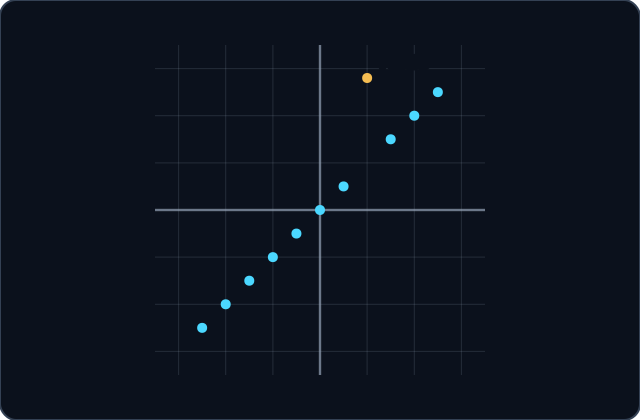
The dots trace except at , where the value has been moved up. The limit at is still , because a limit never looks at the point; continuity fails because the value is not the limit.
The definition, and its three demands
is continuous at when for every there is a such that implies for every in the domain. This is the limit definition with weakened to and replaced by . Equivalently: is in the domain, exists, and it equals .
Reading the definition
- The clause is gone, so is now tested — and it passes trivially, which is why nothing is lost and the value is forced to agree.
- Sequentially: is continuous at exactly when implies , with no condition that the inputs avoid .
Continuity is the limit agreeing with the value
Compare the two conditions phrase by phrase. The continuity condition tests every nearby input including the point; the limit condition tests every nearby input except the point. The only difference is therefore what happens at the point itself, and there the continuity condition asks that the distance from the value to itself be below the tolerance, which it is. So the two conditions impose exactly the same demands.
Proof steps
Continuity tests more inputs, so it implies the condition on fewer.
Backwards, the one extra input the limit condition does not test passes automatically.
So the same radius serves, and the two conditions are equivalent.
Which is the three-part form the definition is usually quoted in.
Applications
Practice
Three Demands at Once
The point must be in the domain, the limit must exist, and they must agree.
Try it
and . Is continuous at ?
Try it
What is the difference between the limit definition and the continuity definition?
Try it
Every function is continuous at an isolated point of its domain.
Continuity Moves Limits
A continuous function may be taken inside a limit; that is what the sequential form says.
Try it
is continuous at and . What follows?
Try it
for . What value at makes continuous there?
Try it
Whether is continuous at can depend on the values of far away from .
Try it
Which function is continuous at ?
What You Learned
- Continuity at a point asks that the limit exist and equal the value.
- The definition is the limit definition with the exclusion of the point removed.
- Sequentially, a continuous function may be taken inside a limit.
- It is a local condition, and it holds automatically at an isolated point.
Final checkpoint
Try it
for and . Which of the three demands fails at ?
Try it
If exists then is continuous at .
Completion
Lesson complete
Great work! You now know how to:
- State continuity at a point in both the tolerance and the three-part form
- Say which clause of the limit definition is dropped, and why nothing is lost
- Repair a removable discontinuity by assigning the limit
- Move a continuous function through a limit of a sequence