Intuition
The definition is the one from the fourth chapter with the index replaced by a distance. A tolerance on the output is given first; a distance on the input must then be produced, such that every input within that distance of the point, other than the point itself, has its value within the tolerance. Where a sequence proof chose a place, a function proof chooses a radius, and everything else about the two is the same.
A machine must deliver a rod within a hundredth of a millimetre of the specified length. Your job is to say how accurately the dial must be set. A tighter specification on the output demands a tighter setting on the input, and the promise is exactly that such a setting always exists.
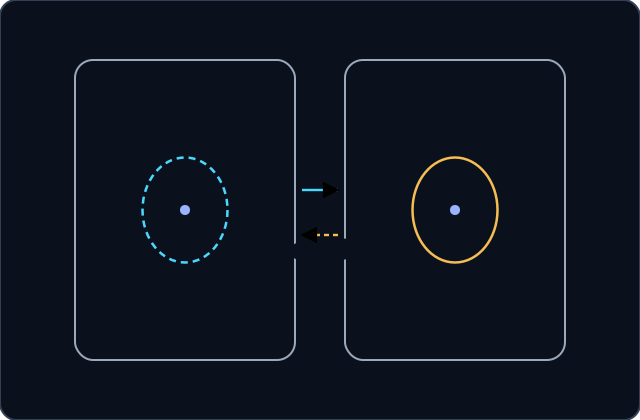
The tolerance is given, drawing the band round in the values. The radius is then chosen so that everything within it of , except itself, is sent inside that band. A smaller usually forces a smaller .
The definition, and the proof it asks for
means: for every there is a such that for every in the domain with we have . The strict inequality is what excludes the point itself. A proof has the four lines of an epsilon–N proof with replaced by , and the scratch work is again solving an inequality backwards.
Working with it
- is chosen after and may depend on it and on . A single answering every would force to be constant near .
A worked epsilon–delta proof
Simplify the distance between the value and the candidate first: for a linear function it is a constant multiple of the distance between the input and the point. The tolerance then translates directly into a radius by dividing, and the proof is written forwards from that choice. Nothing in the argument depends on the particular numbers, which is why every linear function is handled the same way.
Proof steps
The tolerance comes first and the radius will be chosen to suit it.
Simplify the distance between the value and the candidate limit.
Divide the tolerance by the factor the simplification produced.
Take any input within that radius of the point and different from it.
Which is the definition, for the tolerance given — and it was arbitrary.
Applications
Practice
Tolerance First, Radius Second
The quantifiers are in the same order as in the sequence definition, with the place replaced by a radius.
Try it
In the definition, which is chosen first?
Try it
Why does the definition demand rather than just ?
Try it
For and , what is the largest that works?
Try it
If a particular works for a given , then every smaller positive works too.
Restrict First, Then Bound
For anything nonlinear, cap the radius at one before estimating, so the awkward factor can be bounded on a fixed interval.
Try it
Proving , what is the usual first move?
Try it
What does it mean that ?
Try it
If one answered every , the function would have to be constant near .
Try it
Proving with and the restriction : the factor is then at most what?
What You Learned
- The tolerance comes first and the radius answers it.
- excludes the point, which is what makes a limit a limit.
- Any working radius is acceptable, and smaller ones work too.
- For anything nonlinear, cap the radius first and bound the awkward factor on that interval.
Final checkpoint
Try it
A student writes: "Take . Then for every and every with , ." What is wrong?
Try it
The radius may depend on the point as well as on the tolerance.
Completion
Lesson complete
Great work! You now know how to:
- State the definition with its quantifiers in order
- Write an epsilon–delta proof for a linear function
- Cap the radius first when the function is nonlinear
- Negate the definition correctly