Intuition
A limit of a function can be tested with sequences instead of tolerances, and the two tests give the same answer. That turns every theorem of the fourth chapter into a theorem about functions at once, and it gives by far the quickest way to prove that a limit does not exist: find two sequences approaching the point whose values head to different places.
To find out where a road leads, you can measure the direction it points at every distance, or you can simply drive along it — by any route you like — and see where you arrive. The claim is that every route gives the same answer, and that if two routes disagree the road leads nowhere.
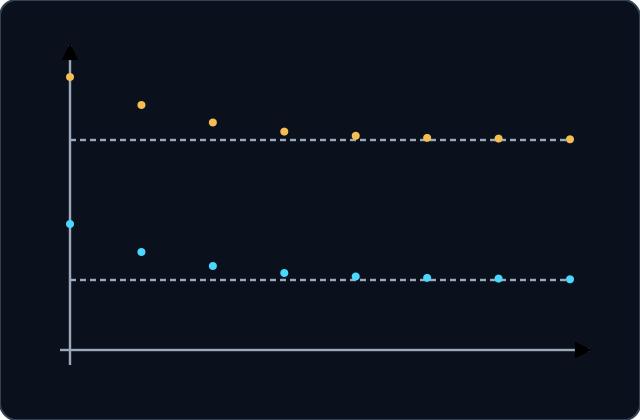
Inputs marching towards the lower level, at , and their values marching towards the upper one, at . The characterisation says this happens for every such sequence of inputs exactly when the limit is .
The two tests agree
holds if and only if for every sequence in the domain with and . The forward direction converts a tolerance into a radius and then uses convergence of the inputs; the backward direction is proved by contradiction, building a sequence out of the radii when the definition fails.
What it is for
- Every theorem about sequence limits becomes one about function limits: uniqueness, the algebra, the squeeze, and order.
- To show a limit does not exist, produce two sequences approaching whose values head to different places. This is the standard method and is far quicker than denying the definition directly.
- The condition matters: a sequence sitting at would say nothing, since the limit ignores the value there.
A limit is tested by sequences
The forward direction is a straightforward chain: a tolerance gives a radius, convergence of the inputs gives a place beyond which they are within that radius, and from there the values are within the tolerance. The backward direction is proved by contradiction: if the definition fails, some tolerance defeats every radius, so taking the radii one, a half, a third and so on produces inputs marching to the point whose values never come within that tolerance — a sequence contradicting the hypothesis.
Proof steps
Forward: the tolerance gives a radius, and convergence of the inputs gives a place.
So from that place the values are inside the tolerance, which is what was wanted.
Backward, by contradiction: some tolerance defeats every radius.
Take the radii one over n in turn and pick an escaping input from each.
That is a sequence of the kind the hypothesis speaks about whose values do not converge to L.
Applications
Practice
Two Routes, Two Answers, No Limit
The quickest way to show a limit fails is to disagree with yourself along two approaches.
Try it
How is it shown that does not exist?
Try it
Why does the characterisation require ?
Try it
Finding one sequence with proves that .
Try it
Which direction of the proof needs a construction rather than a computation?
Try it
The characterisation makes the algebra of limits for functions a consequence of the algebra for sequences.
Try it
Which pair of sequences shows that has no limit at ?
Try it
at rational and at irrational . Along the rational inputs , what do the values converge to?
What You Learned
- A function limit is tested by every sequence of inputs approaching the point and avoiding it.
- Two sequences with different value limits prove the limit does not exist.
- One sequence proves nothing.
- The characterisation imports the whole of the fourth chapter into this one.
Final checkpoint
Try it
How is the characterisation used in practice?
Try it
The sequential condition is strictly weaker than the epsilon–delta definition.
Completion
Lesson complete
Great work! You now know how to:
- State the sequential characterisation with both of its conditions
- Disprove a limit with two sequences
- Import a sequence theorem into a statement about functions
- Say which direction of the proof makes a construction