Intuition
A continuous function on a closed bounded interval is bounded and attains both its bounds. Neither half is obvious and both fail if either hypothesis is dropped: on an open interval a continuous function may run away, and on a closed unbounded one it may approach a level it never reaches. The proof is Bolzano–Weierstrass used twice, and it is the theorem that makes the search for a maximum a sensible thing to do at all.
A road over a closed stretch of country has a highest point on it, and somebody stands there. Open the ends of the stretch and the highest point may be just outside, so that the road climbs towards a summit it never reaches. Nothing about the road changed; the difference is whether the stretch keeps its own endpoints.
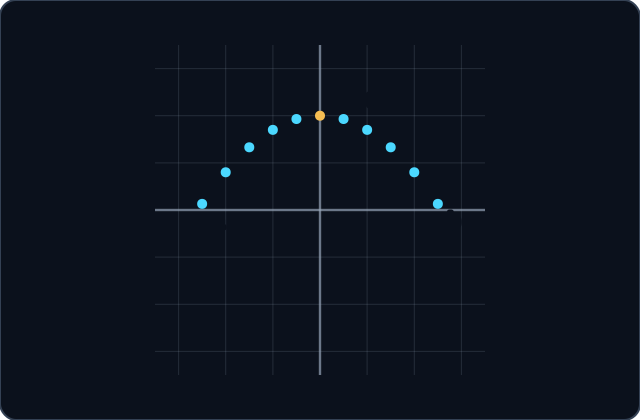
The dots trace a continuous function on a closed bounded interval. The largest value is not merely approached: some point of the interval has it. On the open interval between and this can fail, and on an unbounded one it usually does.
Bounded, and the bounds attained
Let be continuous on . Then is bounded, and there are points with for every . So attains a minimum and a maximum, and the supremum and infimum of its values are values. Both hypotheses on the interval are needed, and so is continuity.
What each hypothesis does
- Open interval: on is continuous and unbounded, and on is bounded with neither bound attained.
The Extreme Value Theorem
Two applications of the same idea. First, boundedness: if the function were unbounded, a sequence of points could be chosen whose values exceed every level, and Bolzano–Weierstrass would give a convergent subsequence, whose limit lies in the interval because the interval is closed; continuity there would then force the values along the subsequence to converge, contradicting their growth. Second, attainment: take points whose values climb towards the supremum, pass to a convergent subsequence, and let continuity transport the limit of the values to the value at the point it converges to.
Proof steps
Suppose the function is unbounded and choose a point beating each level.
Bolzano-Weierstrass applies, and the limit stays in the interval because it is closed.
Continuity makes the values converge, which they cannot, so the function is bounded.
Boundedness gives a supremum, and nothing below it bounds the values.
Bolzano-Weierstrass again, and again the limit lies in the interval.
Continuity carries the values to the value at the point they converge to, which is therefore the supremum.
Applications
Practice
Both Hypotheses on the Interval
Closed and bounded. Drop either and the conclusion can fail.
Try it
Why does on the interval from to , open at the left, not contradict the theorem?
Try it
on all of . Which bounds are attained?
Try it
A bounded function on a closed bounded interval attains its supremum.
Try it
Which theorem from the fourth chapter does the proof use twice?
Try it
The limit of a convergent sequence of points of a closed bounded interval lies in that interval.
Try it
What is the maximum of on ?
Try it
is continuous on . What is its image?
What You Learned
- A continuous function on a closed bounded interval is bounded and attains both bounds.
- Openness, unboundedness or a discontinuity can each break it.
- The proof uses Bolzano–Weierstrass twice and needs the interval closed.
- With the previous theorem, the image is the closed interval from the minimum to the maximum.
Final checkpoint
Try it
On which set is a continuous function guaranteed to attain a maximum?
Try it
A continuous bounded function on an open interval attains its supremum.
Completion
Lesson complete
Great work! You now know how to:
- State both halves of the theorem and all three of its hypotheses
- Give a counterexample for each hypothesis dropped
- Say where Bolzano–Weierstrass and closedness are used
- Read off the image of a closed bounded interval