Intuition
A sequence is a function on the natural numbers, and its limit asks what happens far out along the index. A function on an interval can be asked the same question at any point of the line: what do the values do as the input is brought near a chosen point? The answer deliberately ignores what happens at the point itself, which is what makes the idea useful — most of the interesting cases are ones where the function is not defined there at all.
Two people walk towards each other along a corridor and you want to know where they would meet. The question is answered by where they are heading, not by whether either of them is standing at that spot. A hole in the floor exactly at the meeting point changes nothing about where they were heading.
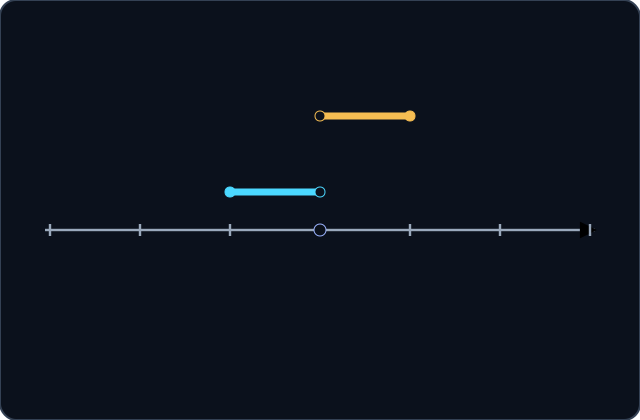
The limit at looks at the inputs on either side of it and never at . The hollow mark says the point is excluded on purpose: may be undefined there, or defined and wrong, and neither affects the limit.
Where a limit may be asked, and what it ignores
Let be defined on a set and let be an accumulation point of : every interval around contains a point of other than itself. Then means that can be made as close to as required by taking in close enough to and different from it. The accumulation condition is what stops the question being vacuous, and need not belong to .
What the definition does and does not see
- plays no part. may be undefined at , or defined with a value unrelated to the limit, and is the same either way.
A limit does not see the value at the point
The definition quantifies over inputs different from c, so any two functions agreeing away from c are being asked exactly the same question. Suppose one of them has a limit. Every condition the definition imposes mentions only inputs other than c, and at each of those the two functions agree, so every such condition is satisfied by the other function as well. The two limits therefore exist or fail together, and agree when they exist.
Proof steps
Suppose the first function has a limit.
Unpack what that means; every input mentioned is different from c.
The two functions agree at every input the condition speaks about.
So the same condition holds for the second function, with the same L.
Applications
Practice
The Point Is Excluded on Purpose
The definition speaks only about inputs different from the point, so nothing at the point can affect it.
Try it
for and . What is ?
Try it
Why must be an accumulation point of the domain?
Try it
What is ?
Try it
For to exist, must be defined at .
Try it
Can be two different numbers?
Try it
For which function does fail to exist?
Try it
If every interval around meets the domain of only at , then is not defined.
What You Learned
- A limit asks where the values head as the input approaches a point.
- The value at the point is never looked at, and the function need not be defined there.
- The point must be an accumulation point of the domain.
- Two functions agreeing away from the point have the same limit at it.
Final checkpoint
Try it
and agree at every input except , where and is undefined. What is true of their limits at ?
Try it
A limit may be taken at an endpoint of the domain.
Completion
Lesson complete
Great work! You now know how to:
- Say what a limit of a function asks, and what it ignores
- Check the accumulation condition before asking for a limit
- Compute a limit where the function is undefined at the point
- Say why a limit is unique when it exists