Intuition
Some functions behave differently on the two sides of a point, and the ordinary limit then fails while each side has an answer of its own. Restricting the definition to inputs on one side gives the one-sided limits, and the ordinary limit exists exactly when both exist and agree. Replacing the band round the limit by a half-line gives limits that are infinite, and replacing the punctured interval by a half-line gives limits at infinity; in both cases only one phrase of the definition changes.
A shop reports different queue lengths depending on whether you arrive before or after the lunch rush. Each approach has a definite answer, and there is no single answer for "at lunchtime". Saying which side you came from is not a weaker question; it is a more precise one.
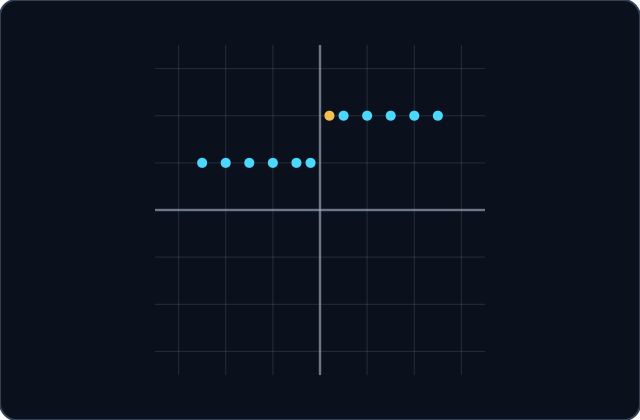
The dots trace a function that is to the left of the origin and to the right. Each side has a limit of its own; the ordinary limit does not exist, because the two disagree.
Four variations on one definition
restricts the inputs to , and to . The ordinary limit exists exactly when both do and are equal. replaces the tolerance band by a half-line: for every there is a with whenever . And replaces the punctured interval by a half-line: for every there is an with whenever .
What changes in each variation
- A one-sided limit exists whenever the point is an accumulation point of that side of the domain, so at the left endpoint of an interval only the right-hand limit is available.
- is not a limit: the function has none, and the notation records the manner of failure.
- is the closest of the four to a sequence limit, with the half-line beyond playing the part of the tail beyond .
Two sides make a limit
Each direction is bookkeeping with the radii. Going forwards, a radius that works for all nearby inputs works in particular for those on one side, so each one-sided limit follows at once. Going backwards, each side supplies its own radius for the given tolerance, and taking the smaller of the two produces a radius that covers both sides — which is the ordinary definition, since every input other than the point lies on one side or the other.
Proof steps
Forward: the one-sided conditions test fewer inputs than the two-sided one.
Backward: the left-hand limit supplies a radius for the given tolerance.
The right-hand limit supplies another.
Take the smaller, so that both conditions are in force.
Every input other than the point is on one side or the other, so it is covered.
Applications
Practice
One Limit, or Two Answers
The ordinary limit exists exactly when the two sides agree.
Try it
and . What follows?
Try it
For , what are the one-sided limits at ?
Try it
If then has a limit at .
Beyond R, Not Beyond N
A limit at infinity is a sequence limit with the tail beyond a place replaced by a half-line beyond a level.
Try it
What does mean?
Try it
For with , what is ?
Try it
At the left endpoint of a closed interval only a right-hand limit can be taken.
Try it
A function is increasing on an interval. What can be said about its one-sided limits at an interior point ?
What You Learned
- A one-sided limit restricts the inputs to one side of the point.
- The ordinary limit exists exactly when both sides exist and agree.
- An infinite limit is a manner of failing, not a limit.
- A limit at infinity is a sequence limit with a half-line in place of a tail.
Final checkpoint
Try it
What are the one-sided limits of at ?
Try it
A function with one-sided limits at every point of an interval has an ordinary limit at every point of it.
Completion
Lesson complete
Great work! You now know how to:
- Restrict the definition to one side and read off a one-sided limit
- Say exactly when the ordinary limit exists
- Read an infinite limit and a limit at infinity correctly
- Say what a monotone function guarantees