Intuition
With variable coefficients the method is the same, and now it earns its keep. Each term of the equation contributes a sum; after shifting, the coefficient of each power gives one equation, and solving it for the coefficient with the highest index gives that coefficient from earlier ones. The coefficients split into two families, one started by the initial value and one by the initial slope, and each family is one solution.
A row of dominoes. Once the first two are pushed — the initial value and the initial slope — the equation knocks down every later one in turn.
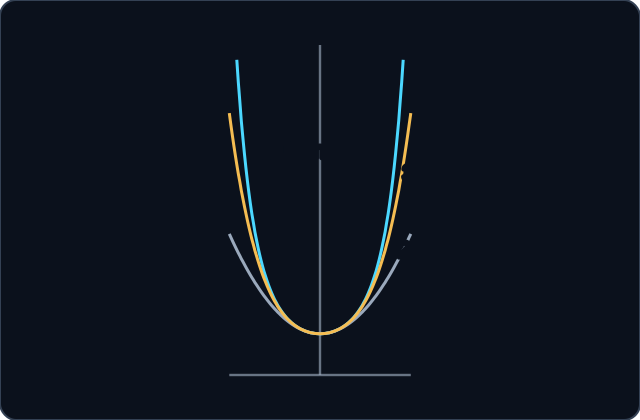
with , . The recurrence gives , which sums to : a solution the method found without it being guessed.
Two families of coefficients
For , substituting gives , so . The recurrence steps by two, so the even coefficients follow from and the odd ones from . The general solution is , where is the even series started at and the odd series started at .
The two families
- Even: , , , so .
The even and odd series are a fundamental pair
The even series starts with 1 and has no x term, and the odd series starts with x. So at zero the first has value one and slope zero, and the second value zero and slope one. Their Wronskian there is one, so by the theorem of chapter four they form a fundamental pair, and every solution is a combination of them with the initial value and the initial slope as the constants.
Proof steps
The even series starts at 1 and the odd one at x.
Read the values and slopes at zero off the first terms.
The Wronskian at zero is not zero.
So every solution is a combination of the two, by the theorem of the Wronskian lesson.
Applications
Practice
From the Equation to a Recurrence
Substitute, shift, collect the coefficient of xⁿ and solve it for the coefficient with the highest index.
Try it
Which recurrence does give?
Try it
For , . With , what is ?
Try it
When a recurrence links to only, the even coefficients are all multiples of and the odd ones of .
Try it
Written over , what does the term contribute to the coefficient of ?
Try it
For with , what is ? Give three decimal places.
Try it
The even solution of with is .
Try it
and . Why are they a fundamental pair?
Try it
Using , estimate . Give three decimal places.
Final checkpoint
Try it
In , the term links the coefficient of to which coefficient of ?
Try it
In the series solution of , the coefficients and may be chosen freely.
Try it
For , for , with . If , what is ? Give three decimal places.
Completion
Lesson complete
Great work! You now know how to:
- derive the recurrence for an equation with variable coefficients
- split the coefficients into an even and an odd family
- prove that the two series are a fundamental pair
- recognise a familiar function in a series solution