Intuition
The recurrence is the whole solution in compressed form. Unwound, it gives a formula for every coefficient, and from that formula two things can be read: whether the series stops, which makes the solution a polynomial, and how far from the starting point the series converges. The ratio of consecutive coefficients answers the second question, just as the ratio test does in the analysis course.
A family tree. Knowing how each generation follows from the one before, you can trace any descendant back to the founders without drawing the whole tree.
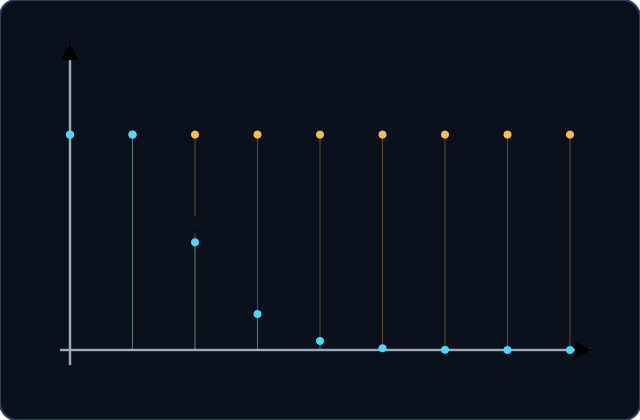
The coefficients against . Those of , , shrink faster than any geometric sequence, so its series converges for every . Those of , the solution of with , stay at , and the series converges only for — up to , where the coefficient of vanishes.
From the recurrence to the series
A recurrence unwinds into a product: . If some factor is zero, that family of coefficients stops and its solution is a polynomial. Otherwise the ratio test of the analysis course, applied to consecutive non-zero terms, gives the reach of the series: when , it converges for , and for every when .
Reading a recurrence
- gives .
A ratio tending to zero means convergence everywhere
Compare consecutive terms of the series at a fixed x. Their ratio is the ratio of the coefficients times x squared, and since the coefficient ratio tends to zero, so does this, whatever x is. The ratio test of the analysis course then gives convergence at every x.
Proof steps
The ratio of consecutive terms of the series.
For every fixed x the ratio tends to zero.
By the ratio test of the analysis course.
Applications
Practice
Unwinding a Recurrence
Apply the recurrence repeatedly from the first coefficient and look for the pattern in the product.
Try it
with . What is ?
Try it
with . What is ? Give three decimal places.
Try it
has a polynomial solution.
Try it
Which recurrence makes the family of even coefficients stop, giving a polynomial?
Try it
The recurrence is started from , . What is the degree of the resulting polynomial solution?
Try it
If , the series solution converges for every .
Try it
A series whose coefficients step by two has . For which does it converge?
Try it
For Legendre's equation the recurrence is . With , what is ?
Final checkpoint
Try it
Why can a series solution of about fail to converge beyond ?
Try it
A recurrence linking three coefficients can still compute as many coefficients as are needed.
Try it
For , what does tend to?
Completion
Lesson complete
Great work! You now know how to:
- unwind a recurrence into a formula for the coefficients
- find the polynomial solutions a recurrence allows
- prove convergence everywhere from a vanishing ratio
- read the reach of a series from its coefficients